
Dana Mejia: A Woman Worth Watching
Prologue
In a world full of noise — of women performing effortlessness and men applauding the performance — the rarest thing left is composure. The one that’s always acknowledged without request. I didn’t invite Dana as a friend. I invited her as someone who makes fashion feel human again. At twenty-one, she is already a veteran of rooms who’s driven like a knife. She works harder and smarter, and it shows. The Row, Proenza Schouler, Christian Louboutin, Salvatore Ferragamo and Chanel. Her résumé could speak for her, but it doesn’t have to, her closet already does.
I wanted the reader to feel what I feel in her presence. She’s a girl who has what most only perform, what others aspire to from their Pinterest boards: authentic sophistication.
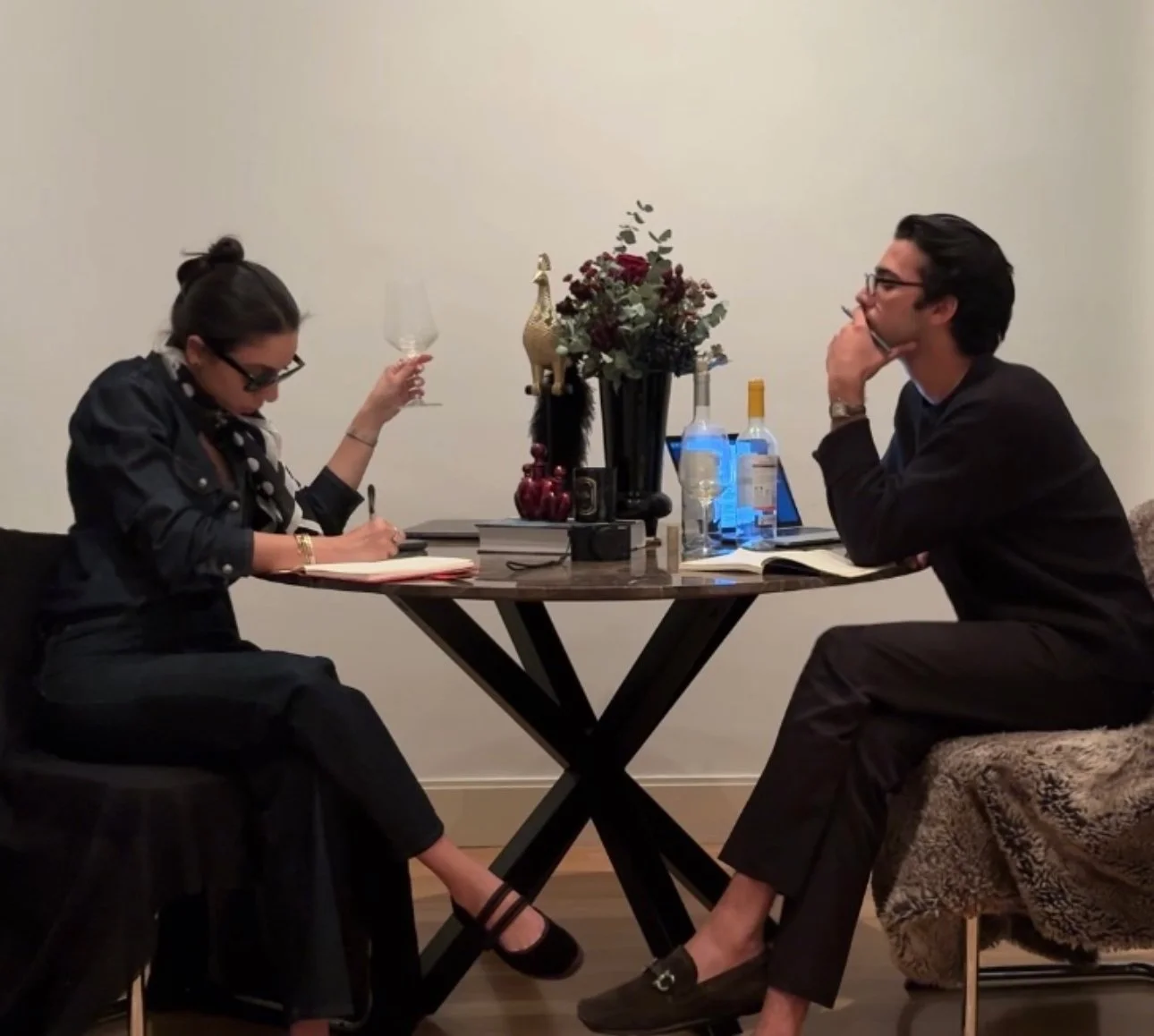
I like to preserve the nature of spontaneity so I caught her off guard, as I tend to do and pulled out my journal. The same one where I draft my articles. She didn’t expect I’d be taking notes which was precisely the point. Nothing premeditated, nothing staged. I like truth better when it isn’t rehearsed.
FREDDY: I’m surprised we’re drinking wine.
DANA: I know. We’re so used to having vodka in our hands that this feels like a detox retreat.
Prelude
As Autumn in Rome by Peggy Lee began to play from the other room and our glasses of chardonnay began to sweat, I asked my first question.
FREDDY: How do you see beauty now, compared to before?
DANA: I see beauty as freedom. As authentic freedom. Acceptance, purity, comfort with your most naked self. Travel, learn, read, listen, speak — absorb everything. Then filter it. Whatever remains inside… that’s beauty. That’s your naked self. That’s how you walk through life.
She doesn’t talk much about herself, maybe that’s why she perceives more than most. Remove one sense, and the others heighten. There’s vision behind her silence.
DANA: When you look at a painter’s work, you’re seeing their traumas, victories, dullness and glorious moments. Consciously or not, it’s all there. If you can borrow an artist’s glasses and look at the world through their filters, you understand why someone is into leather, a certain silhouette. Even why someone prefers real fur instead of faux. What you put on is telling. It’s a façade, but an honest one.
She’s a visual anthropologist. She’s obsessed with consuming work that reflects the spirit of people. She told me that the most beautiful images are the ones that show the “messiness of a lifestyle” — the duality of working and partying, the socializing and meditating, the sweat and the perfume.
FREDDY: How do you manage to be eccentric and still timeless?
DANA: I grew up with structure. Women with immaculate taste—my mother, my grandmother—clean, polished, impeccable. My father’s the definition of a cool man. I think that’s where it starts.
She took a sip, and then added:
DANA: When you’re raised with structure, you learn proportion, not just in clothes, but in life. You learn what balance feels like. And once you know that, you can play with chaos. You can wear something unexpected because you instinctively know when to stop. That’s the difference between eccentricity and bad taste. My mother used to say, “I’ll let you be creative, but inside the frame.” I could pick the shirt, I could pick the pants, but altering the frame was out of question. That stayed in me. Structure lets you misbehave beautifully.
Listening to her, I understood where her balance comes from. Her mother had built her a method disguised as simplicity: You’ll wear a shirt and pants; you choose which ones. It was a box where creativity learned discipline. As Dana grew, the box expanded. The boundaries blurred, but the instinct remained. That’s why she can play and have fun wearing a Zimmermann maxi skirt paired with a The Row knit sweatshirt while still look composed. Freedom, when trained early, never forgets its shape.
DANA: I don’t believe in work smarter, not harder. I say, work harder and smarter.
She speaks with the authority of someone who’s already survived fashion’s machinery, which, given her age, is either impressive or mildly concerning. Her Chanel chapter alone gives me enough material to produce a short film on its own: nearly a year of silence, rescheduled interviews, sudden calls at ungodly hours and the pursuit of a job a million girls dream of. When the final call came, she was in awe. Which, frankly, is the only appropriate reaction when Chanel finally decides you exist.
DANA: I thought they’d moved on. I said to the recruiter, “I thought I didn’t get it,” “It’s been a week and a half after my interview and I hadn’t heard from you”. And then my recruiter said, “Darling, this is Chanel.”
FREDDY: Oh my god (laughs), that’s fabulous! The chicest “of course.”
There’s something so inherently Chanel about being fashionably late with good news. Then, as Michelangelo Antonioni by Caetano Veloso started playing, I couldn't help myself but to dig deeper into her character.
FREDDY: Do you dress like the woman you are, or the woman you want to become?
DANA: No. The woman I am. Maybe a bit of both. I’d rather wear my emotions than explain them. I was insecure before. When I look back, I hate my old style — and that’s good. That means growth. I understand that Dana; I understand this one too. Evolution is my constant.
FREDDY: Growth, I think, is the feeling of disliking your past gracefully.
FREDDY: I know you’ve met a lot of upcoming talent, and of course, you’ve had an impressive trajectory despite your age. You’ve met incredible designers, artists and thinkers. But who, out of all of them, has left a lasting impression on your subconscious? Who lingers in your mind — who moves a girl like you?
DANA: Daniel Roseberry. Next question. I truly love that man.
She said it without hesitation. The kind of conviction that makes you trust her taste immediately. Then she elaborated, speaking of the amazing craftsmanship and artisanship that Daniel and his team brought back to Schiaparelli — especially through haute couture.
DANA: But I must admit, I also fancy Coco. She was a woman with so many references back in her day — way ahead of her time. She pushed boundaries that people still don’t realize were monumental back then. And perhaps she’s the one responsible for my fever for denim. (She laughs — and it makes sense. Dana has exceptional denim.)
FREDDY: Chanel wishes they could do the haute couture Schiaparelli does, and Schiaparelli wishes they could do the ready-to-wear that Chanel used and will continue to do. It’s the eternal rivalry — the sexy little dance between Elsa and Coco.
DANA: Coco has always been Chanel’s creative director, even when she wasn’t.
FREDDY: I absolutely agree. Karl was an innovator, yes — but he was an innovator who saved a stuck vision through evolution, not erasure. He never changed the Chanel woman; he just gave her new settings. He let her step off the private jet, walk down the grocery aisle, board a spaceship. He showed us the Chanel lifestyle — not just the clothes. Chanel as an ecosystem.
DANA: I remember when I saw him. I was thirteen, in Paris — Place Vendôme. We were in the same store. He arrived in a black, glossy Rolls-Royce with the silver Spirit of Ecstasy.
FREDDY: As he would.
DANA: It was a hideous store. Sportswear. The kind of place you’d never expect to encounter a man like him. Honestly, I didn’t even know what I was doing there myself. We didn’t speak. We didn’t lock eyes. But just being in the same room, observing him… it was special. It taught me that one can be the chicest thing in the room even when surrounded by sneakers and hoodies.
FREDDY: Speechless.
DANA: I remember exactly where I was when he died, in Washington, about to start a debate. I saw the headline and thought, please, not right now. And then I said to myself… “Damn, I wish I were that cat. That fucking Choupette.”
Dana communicates through gestures more than words. During Fashion Week this year, she sent me a location pin: Plaza Mayor. No context. When I arrived, she’d rented an Airbnb with her family just to watch the latest Carolina Herrera show from above. A two-night rental for an hour of beauty. The official video of the collection looked flat by comparison. From that balcony we saw everything — the fabrics, the movement, the illusion of perfection — and exchanged glances that said, yes, this is what we live for.
It’s the same intention she brings to everything. You’d expect Dana’s favorite flowers to be camellias, but they’re not. They’re white and black anemones. It makes sense, really. The contrast mirrors her. Where others would pick the emblem, Dana picks the essence. She despises clichés — even when we’re talking bouquets.
FREDDY: What preoccupies you most about the industry today?
DANA: Luxury isn’t that luxurious anymore. It ties back to your debut article, It’s a Famine of Beauty. Exclusivity has died of overexposure. If anyone can have it, it’s not luxury. That’s why people outside fashion don’t get FOMO — they’re not missing out. Brands confuse inclusivity with accessibility. Why invite influencers? There’s press, there’s critics. Why people who got lucky due to algorithm?
FREDDY: You’re so right darling. We’re in post-influencer fatigue. Inviting someone who doesn’t breathe fashion to a couture show is like asking someone who’s never heard a symphony to conduct one.
DANA: Exactly. You can be a rich fat billionaire spending ridiculous amounts of money every month and still have no class. Luxury isn’t an invoice.
Epilogue
DANA: We cooked.
FREDDY: We had to. People are starving.
As I thanked her for her time, Dana left my home to continue being the fabulously chic, modern woman she represents and carries on her shoulders. I spent the next few days writing this, reliving the conversation and rewinding her words. I wrote while Prelude in C-Sharp Minor by Rachmaninoff played on loop. Dana Mejia is a woman with a disarming clarity about who she is. She moves through life with a self-awareness that feels both rare and enviable. She rarely dresses overtly provocative, nonetheless, there’s an undeniable sensuality to her — proving that intellect and taste are irresistible. The sky is the limit for a girl like her.
People like Dana make a conversation worth having, make time worth spending and make memories worth remembering. She is, without exaggeration, one of the most cultured young women I’ve had the pleasure to encounter — a girl from a small island with a vision bigger than herself.
So when the industry finally shifts the spotlight toward her — as it will — I want everyone reading this to remember one thing:
Freddy Espinal said it first.
WRITTEN AND EDITED BY FREDDY ESPINAL
