
Antonio Del Canto Spring/Summer 2027
Before anyone walked in, Chopin’s Nocturne No. 20 was playing throughout the room. It softened the ambiance into something intimate: melancholy, vulnerability, and privacy. Considering that Dress Up Spring 2027 is built around the ritual of getting dressed—the interval between being alone with oneself and becoming visible to somebody else—it was an intelligent way of putting the audience inside the collection’s emotional frequency before it had begun. Del Cantos's official premise revolves around that threshold: the dressing table as an altar, surrounded by perfume, jewellery, flowers and mirrors while identity is still in the making.
Through the first look, black met white immediately.
The opposition was useful because paradox became one of the collection’s persistent habits. Covered and uncovered. Fragile and rigid. Silk and leather. Getting dressed and undressed are technically opposite actions, yet both require the same intimacy.
Then teardrops came.
They dropped from necklaces. Slipped from waists. Appeared against backs and torsos, changing location often enough that the motif never reduced itself to a logo.
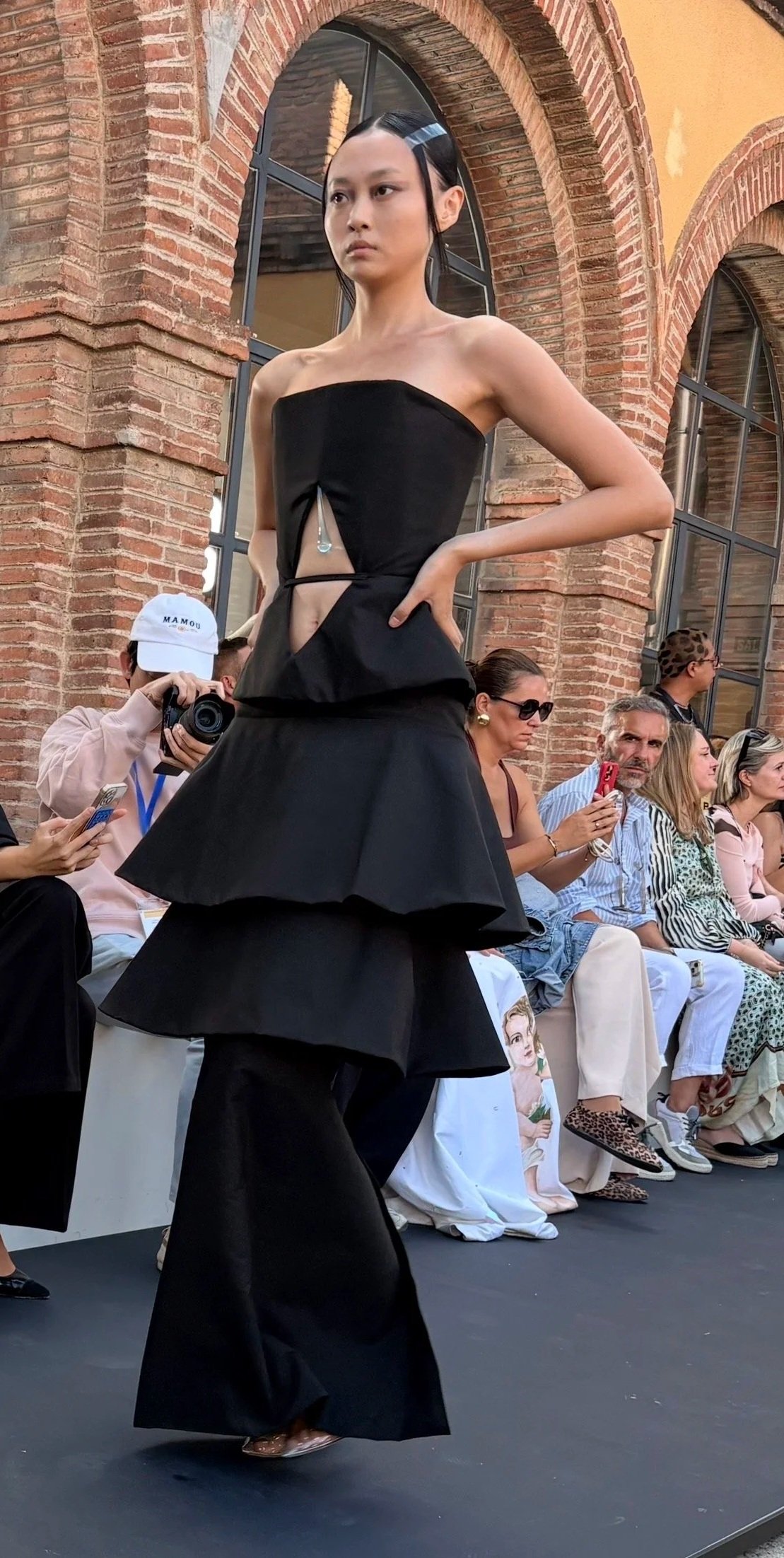
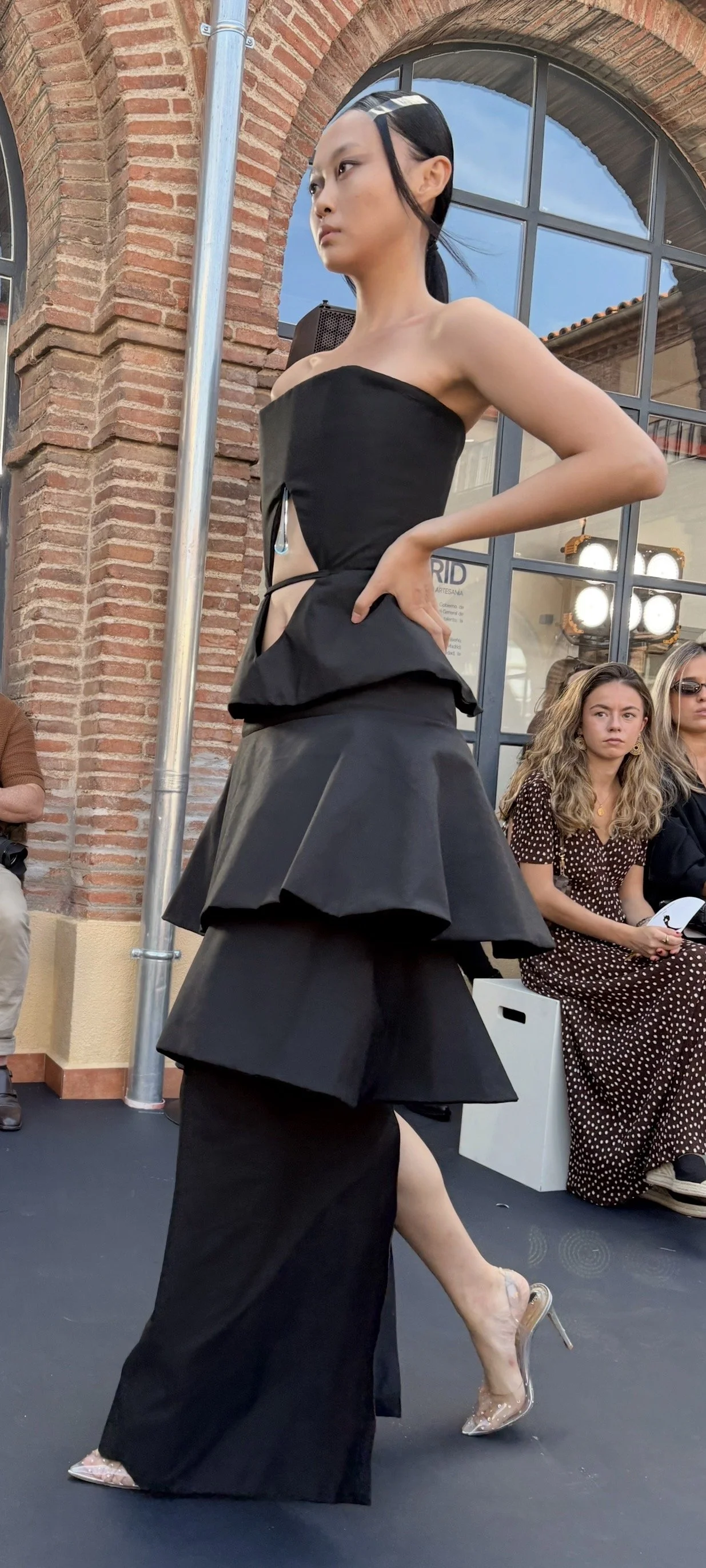
One particular black dress stacked several layers of skirt before falling straight toward the floor, leaving the centre of the abdomen exposed. A pale, translucent blue drop descended toward the navel like a beautiful punctuation. Antonio describes these Murano-glass pieces as traces of perfume or frozen tears.
Dress Up also clarifies something already present in Antonio’s work. Last season’s Vertige explored altered states of consciousness—insomnia, dissociation, delirium and the instability between waking and dreaming—through translucent materials, distorted proportions and ethereal silhouettes. Here, vulnerability has come closer to an earthly realm. Vertige asked what happens to the body when consciousness becomes unstable. Dress Up asks what happens to identity in front of a mirror five minutes before leaving the house.
The result produced a more human collection.
At one point, a model quite literally adjusted her white lace top.
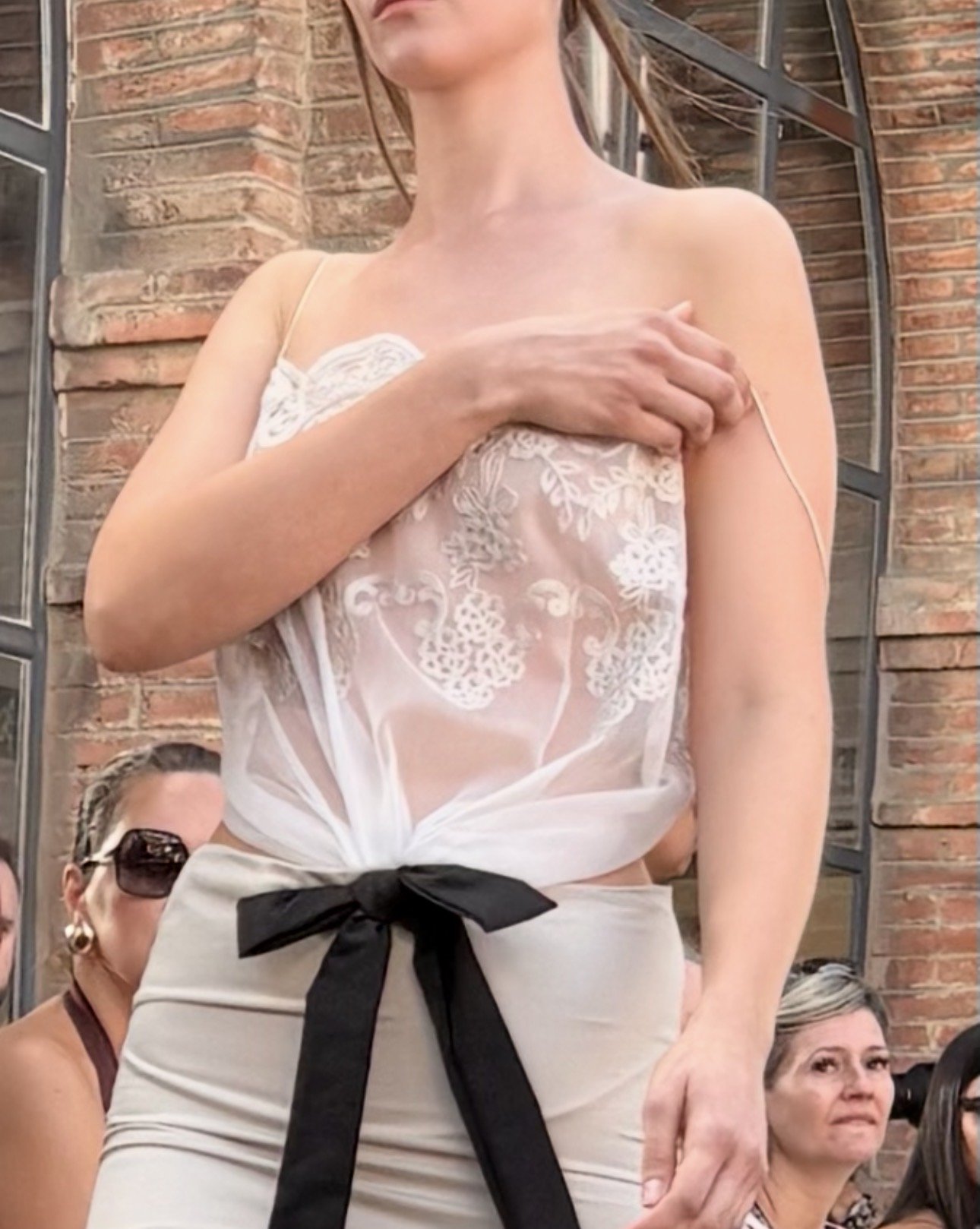
Whether choreography or simply necessity barely mattered. It read as completely proper. The collection is interested in clothes before the performance of dressing has been completed, and suddenly here was the performance malfunctioning—or completing itself—in public.
Antonio likes flowers.
I’m not fully persuaded by all variations presented.
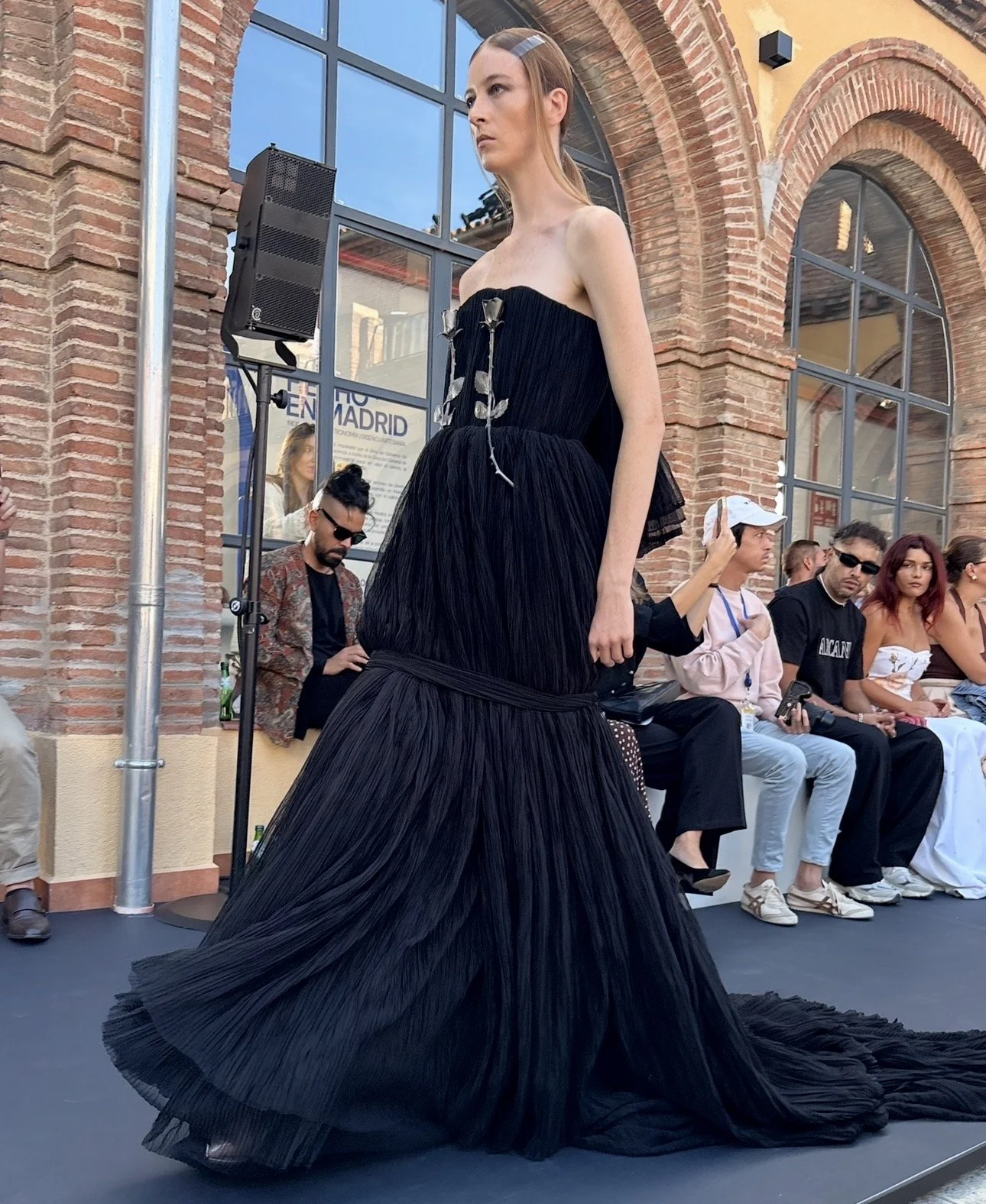
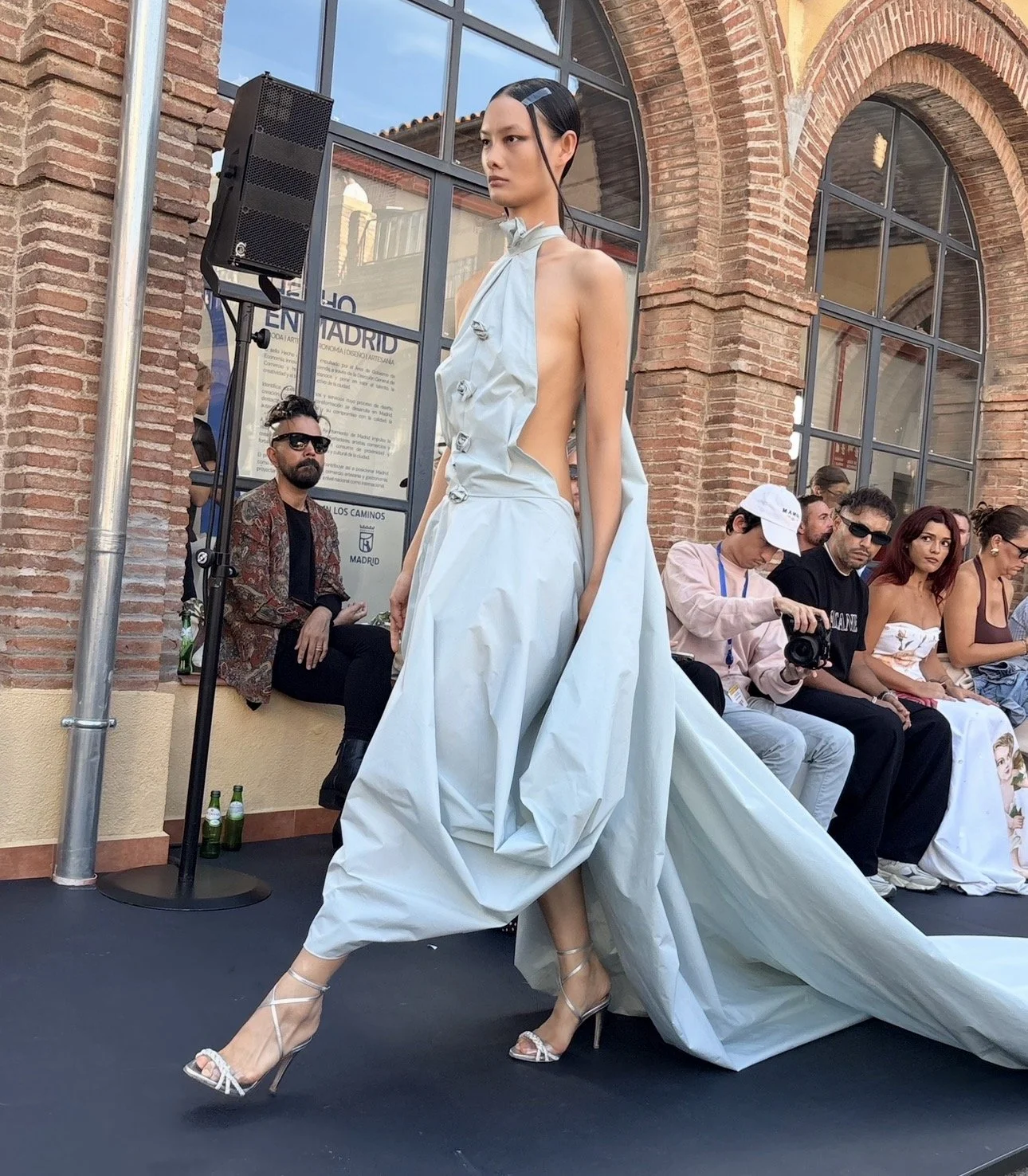
The collection’s sculptural flowers are forged iron, intended to place something permanent and structural beside something fleeting and delicate. Conceptually, perfect. Visually, their hard finish occasionally became almost synthetic-looking against the softness of the fabric sustaining it. Intention does not automatically overturn a visual clash. If the objective was friction, friction was certainly achieved; I simply did not always enjoy the material of it.
A large celeste dress proved that beautifully. Four flowers constructed from the same material as the dress sat down its centre while a generous train extended behind the model. Nothing appeared to have landed on the garment from elsewhere. Even the strapped shoes remained within its tonality. The difference is clear: one flower interrupts the dress; another flirts with it.
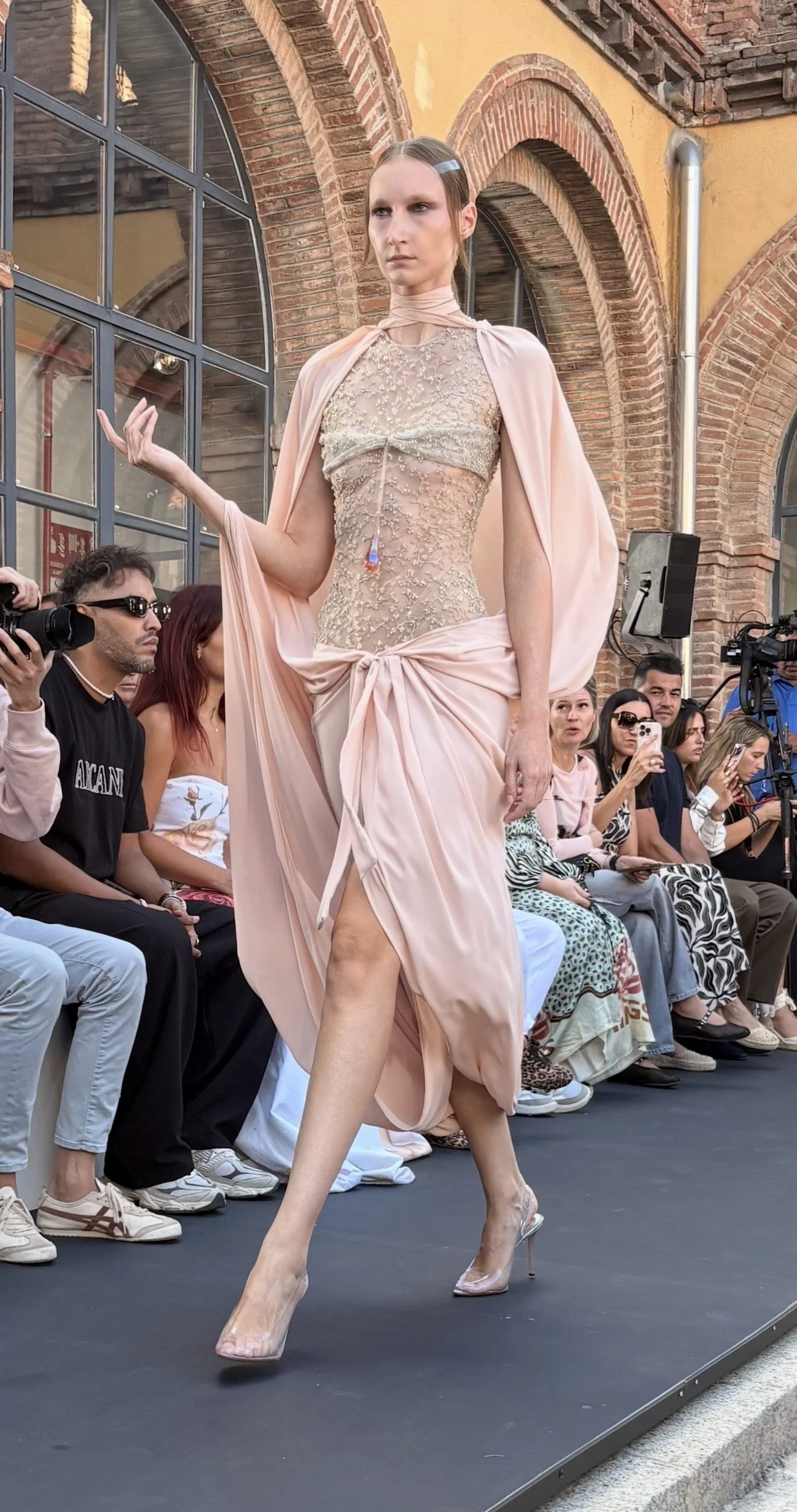
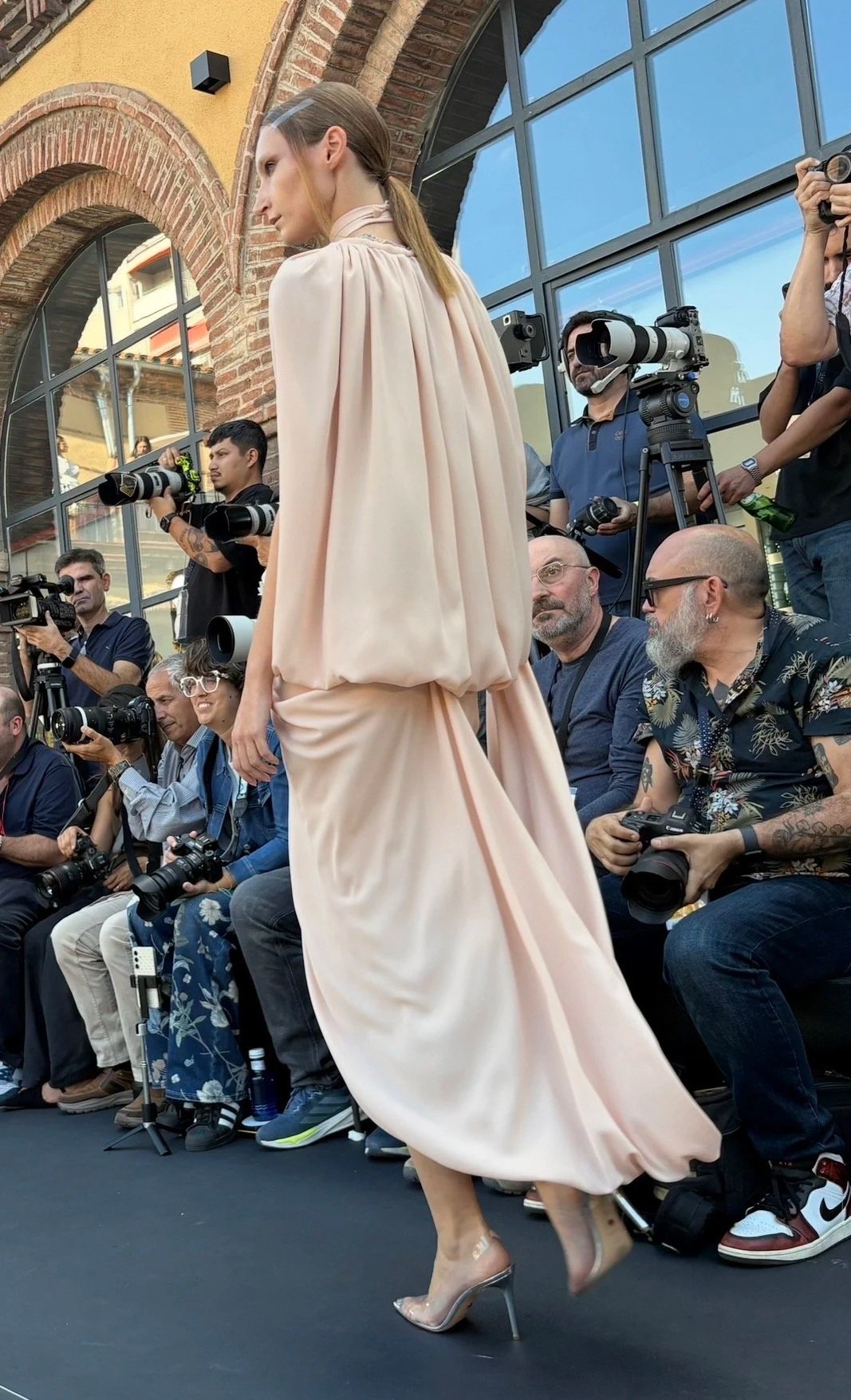
A pale coral look made me think, whether Antonio intended it or not, of The Birth of Venus. Not literally. The model did not impersonate Botticelli. But one arm lifted with a particular grace of being observed; translucence fell around the body like a cape; an iridescent teardrop descended from the breast toward the stomach; whilst skin remained exposed between the softness of the textile and the clarity of the heels.
Venus kept entering my peripheral vision throughout the show. Perhaps it was the watery palette. Perhaps the soft, clouded colours. Perhaps it was the way silk repeatedly seemed to have been placed onto bodies that had only just emerged from somewhere. The models looked athletic and defined, which prevented sensuality from becoming languid.
Then Antonio put one of them in brown leather.
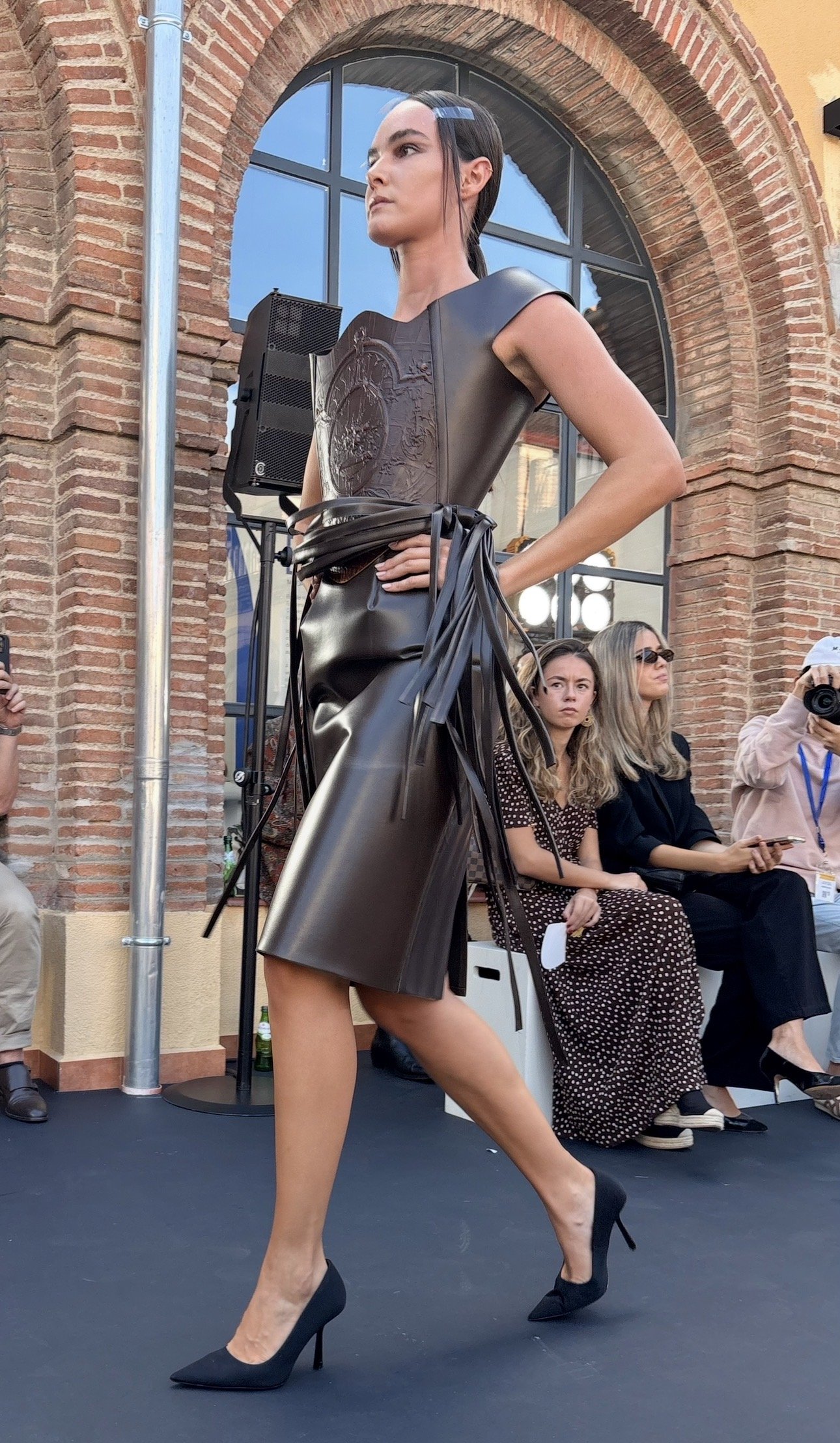
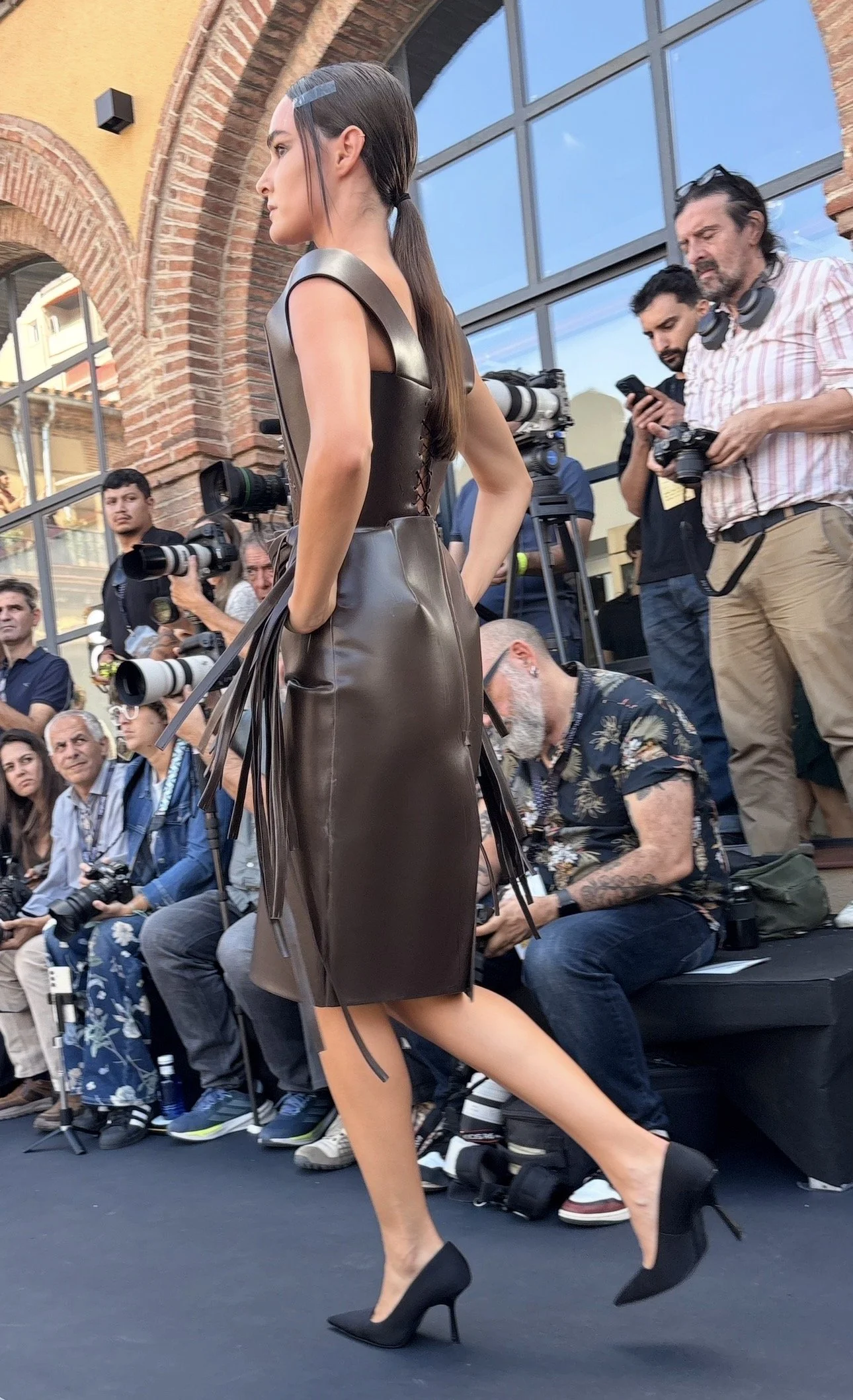
After so much softness, the leather look read like armour. Its torso was more resistant, its material less willing to surrender. Dressing, after all, is not only an act of seduction or self-expression. It can be a defence mechanism. We decide what to cover before leaving the house for reasons considerably personal. A garment can prepare the wearer to be looked at by protecting exactly what they do not want looked at.
That made the leather more than a palate cleanser. It represented the other psychological possibility contained within the collection’s premise.
The opposite was a celeste silk dress crossed through the waist by two bands of fabric.
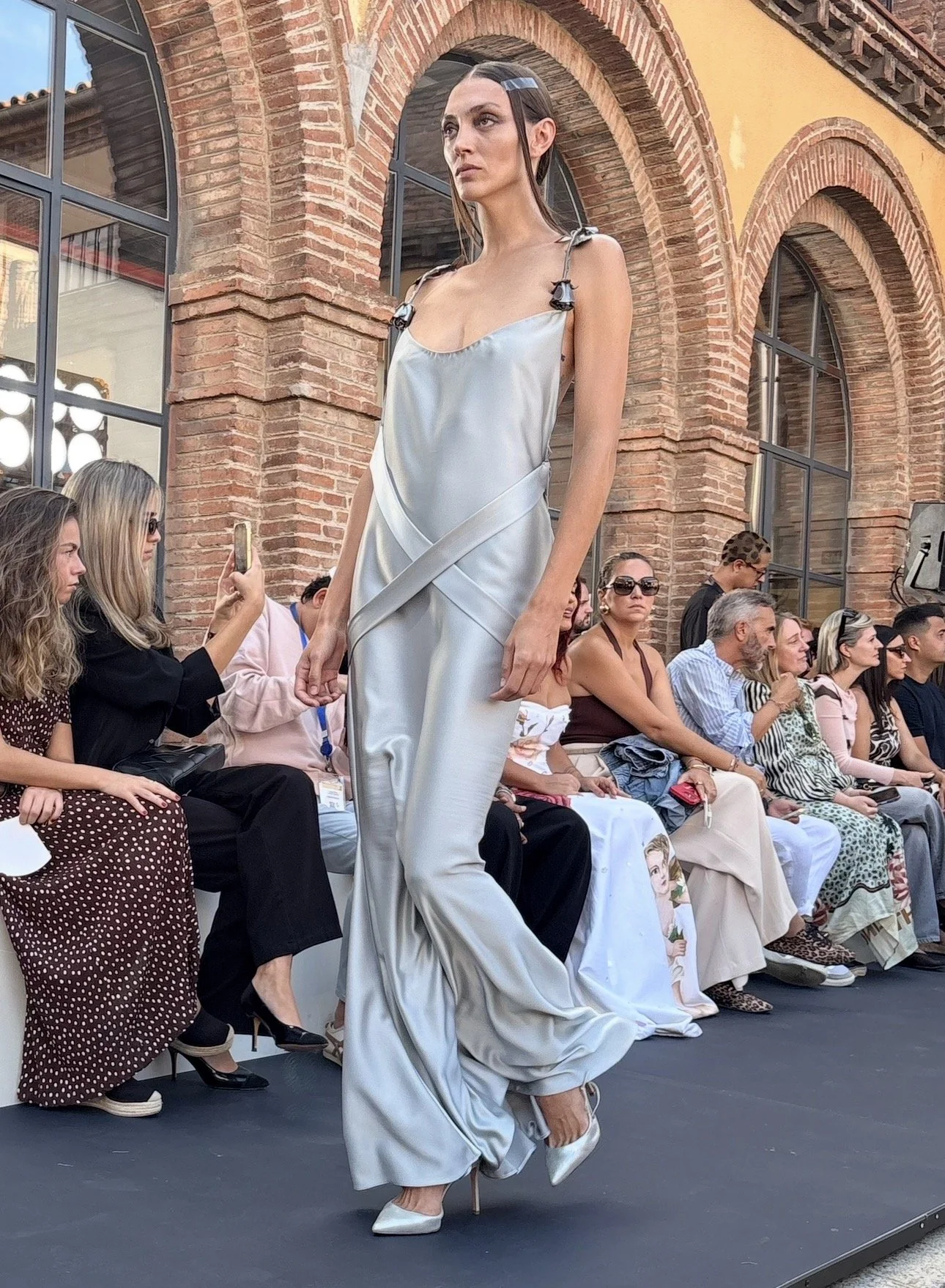
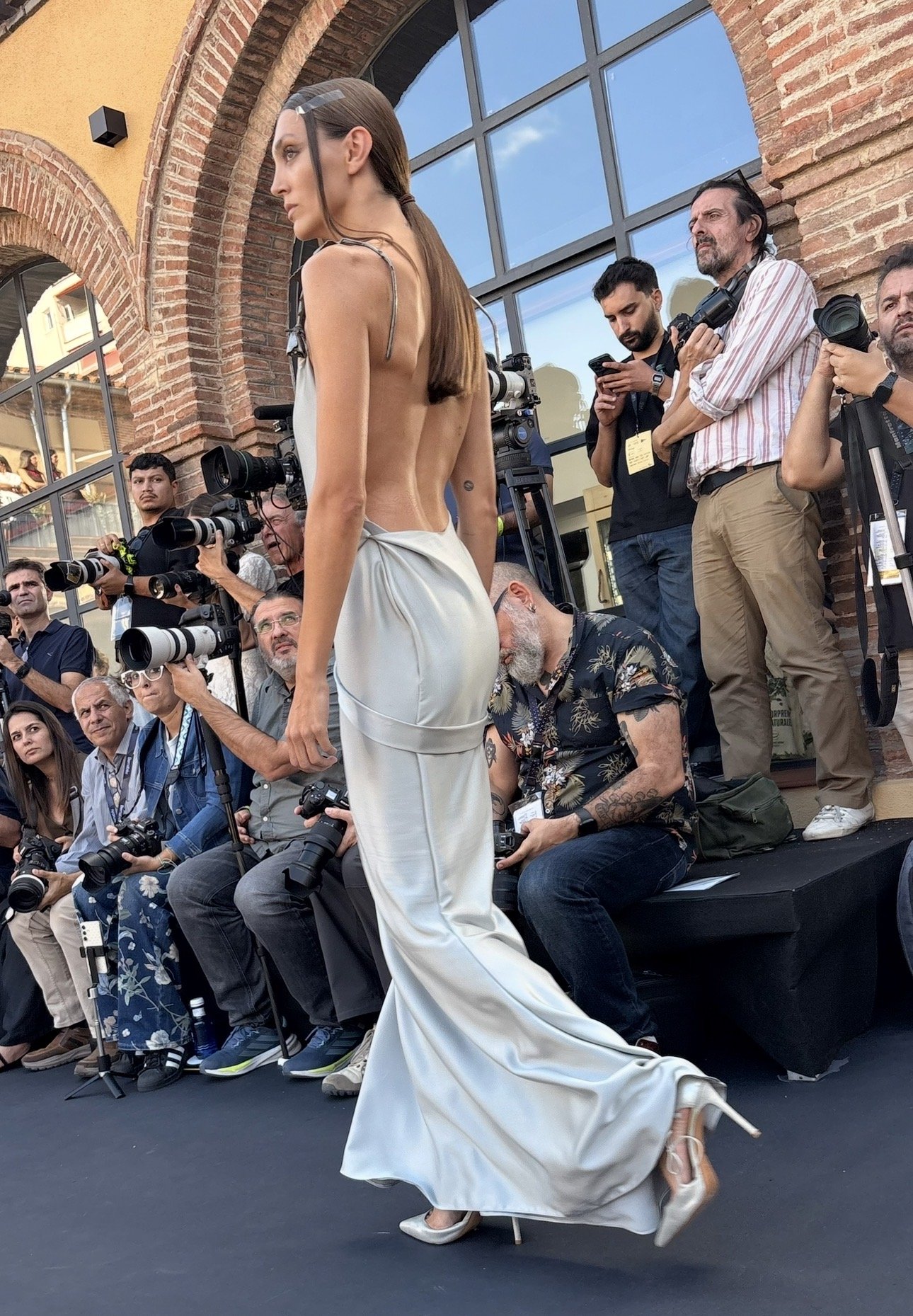
The silk followed the torso with softness; the crossed construction contoured rather than blurred the body, leaving movement to finish what cutting had begun. From the back, it opened. In motion, it hugged. Sexiness here was not being made through nudity alone but through the relationship between fabric and anatomy.
Those moments of liquid silk occasionally summoned the Galliano-era Dior for me—the years when bias-cut silk, lace, lingerie and the exposed body seemed capable of dressing one another. Dior Spring 2002, for instance, contained bias-cut silk dresses and sheer pieces; Fall 2000 ended in lingerie-pink and black lace. The association is useful only up to a point. Antonio’s glass tears and fixation on the psychological threshold between private and public give his softness a different purpose.
There is another fashion memory here: Jean Paul Gaultier Spring 1997, where models dressed, unzipped and altered garments while already walking down the runway. But Gaultier treated dressing almost as mischief. Antonio treated it as vulnerability.
On another note, not every colour belonged as convincingly.
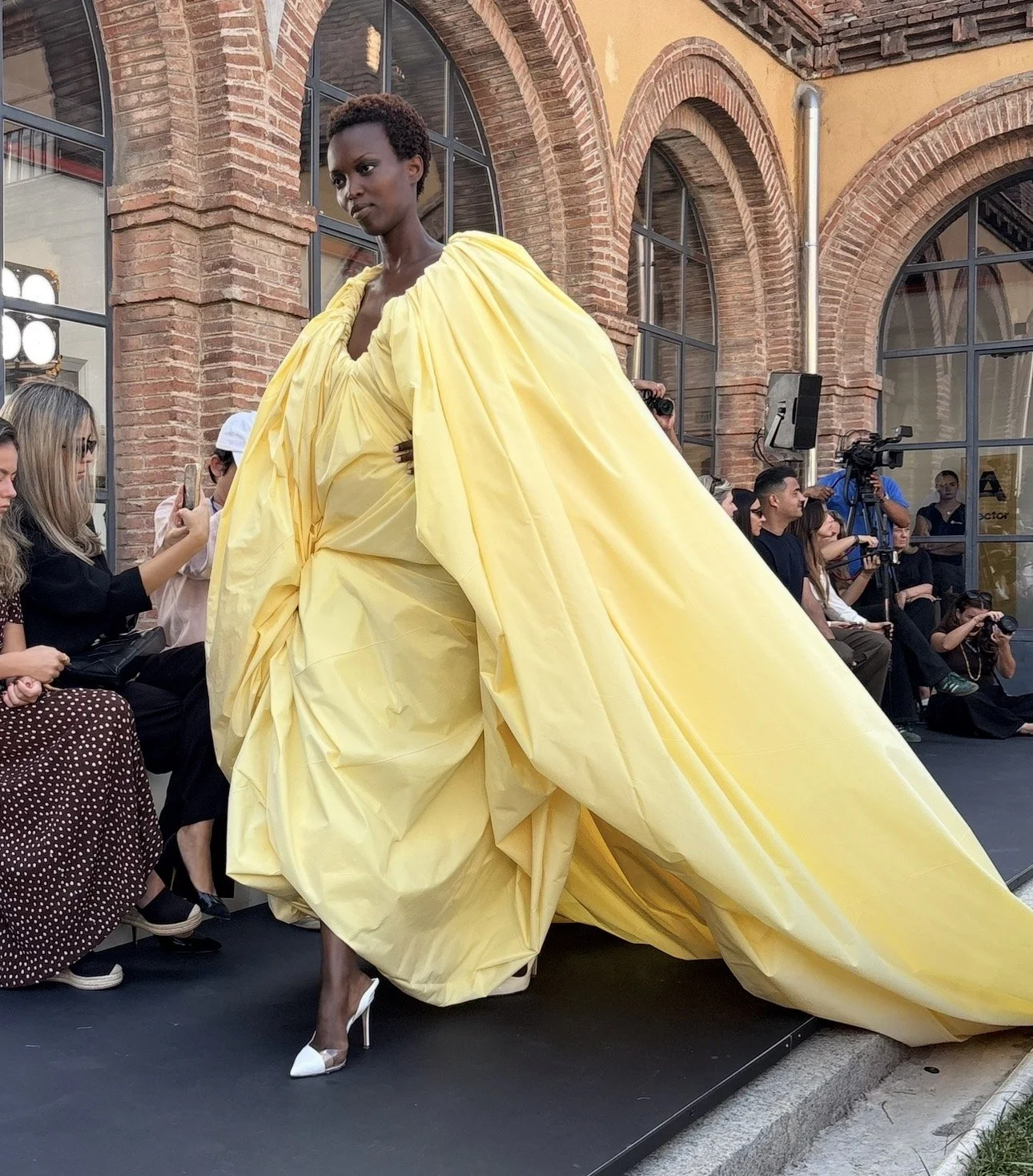
The pale yellow look understood volume, but less the emotional climate of the palette around it. Few looks shown of bright pinks fall under that same category. Against black, ivory, and those dream-like blues, they felt less like escalation than interruption—as though somebody had opened another drawer of the closet halfway through getting ready.
The cloudy blues were among the best things in the show. So were the shorter silk dresses. A pale version layered darker lace over white with a delicacy that avoided preciousness. Another silver-celeste mini placed an oversized glass drop at the chest, with fabric folding into something almost bow-like around it.
And then, from a distance, came a woman in white.
The sunlight hit the model before I could properly see her dress in detail, and for a few seconds she appeared less like a model approaching than a body of light slowly taking human form.
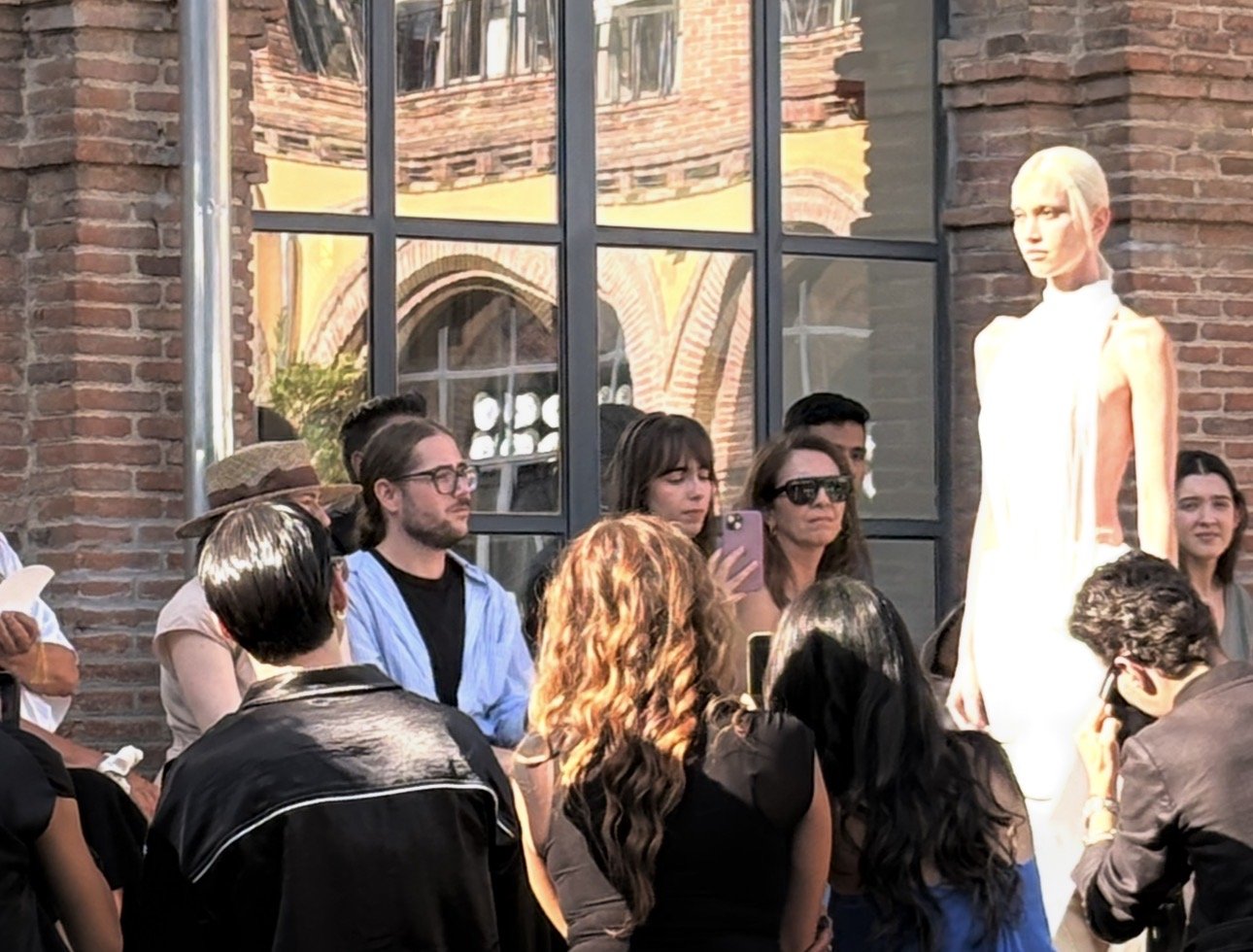
As she came closer, the garment became more complex. Fringe travelled from the neck, broke around the torso, concentrated at the waist, and then fell like a cascade. Because everything was white, texture had to perform the work that colour normally would.
And as she walked.
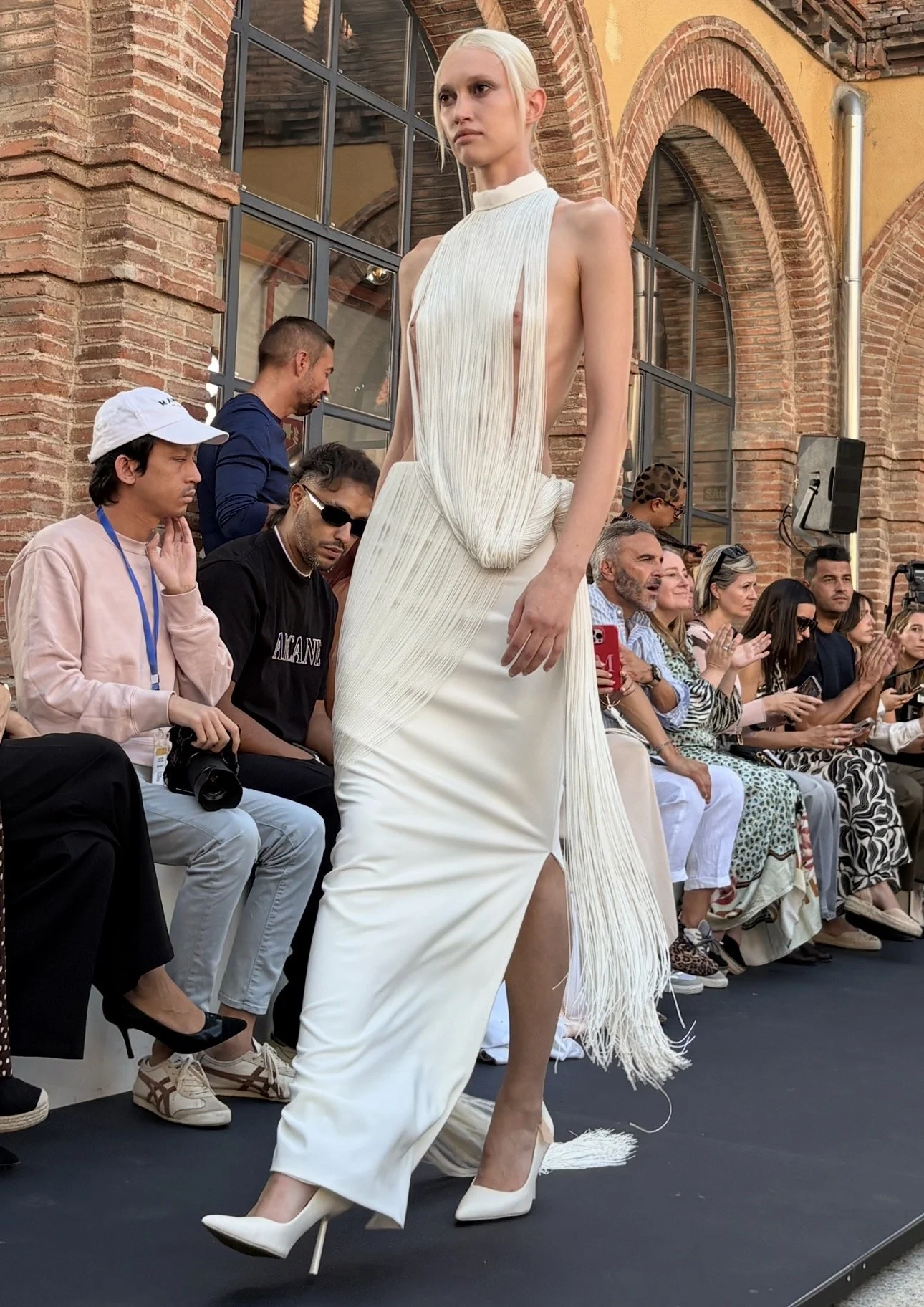
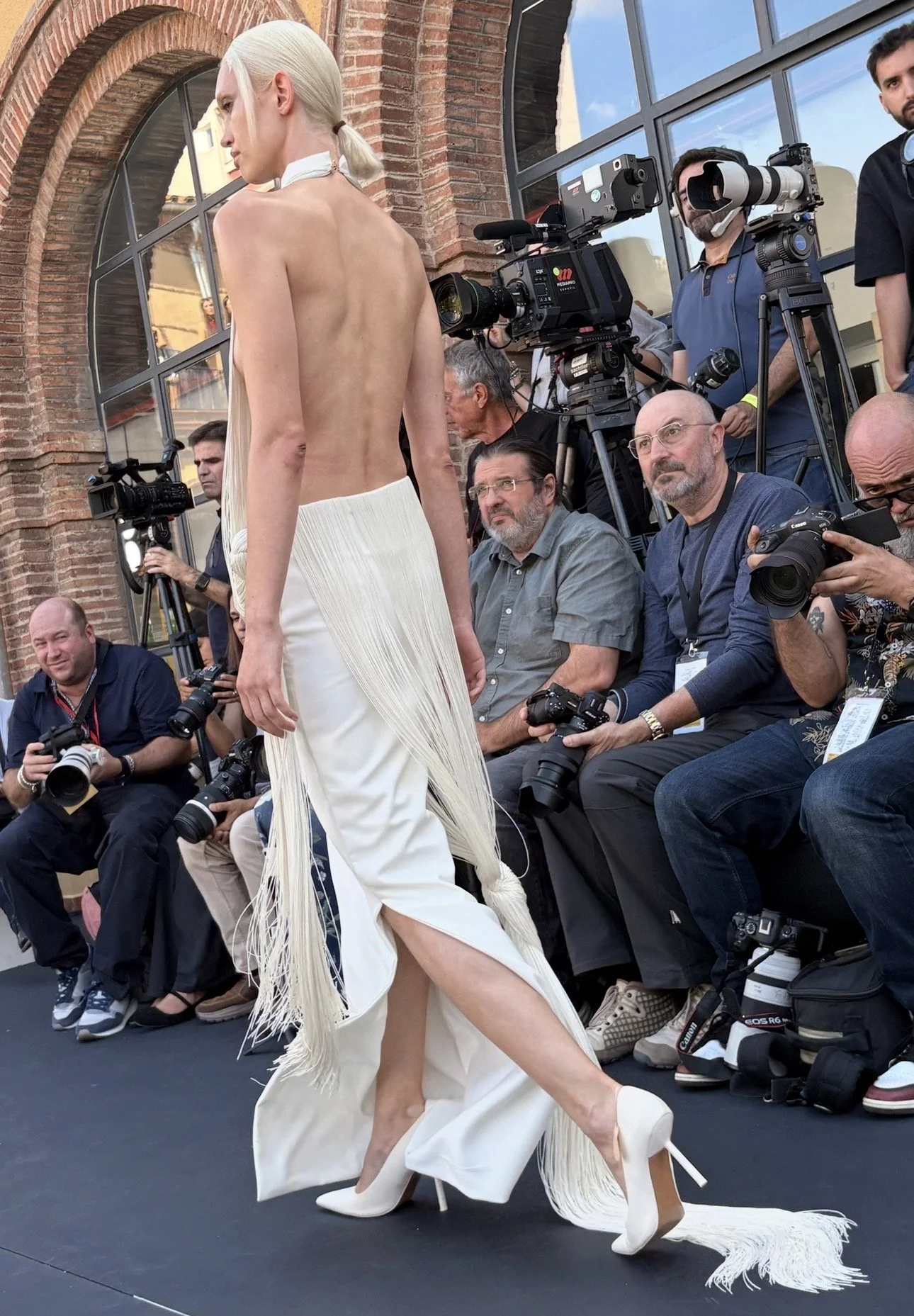
Fringe covered her nipples, then uncovered them.
Concealed and exposed.
Suddenly, the collection produced its entire argument in a single look.
Nudity is intimate. Dressing is intimate. Undressing is intimate. Here, the garment repeatedly moved through the body between those conditions with every step she took. She was neither fully concealed nor explicitly exposed. The clothes were getting dressed and undressed while being worn.
I can only say it was… chef’s kiss.
It also exposed one of the show’s few contradictions outside the clothes. The music that accompanied the actual runway occasionally became much more electronic, almost video-game-like. It was not bad. It simply seemed to belong to a harder, more superficial collection than the one I was witnessing. Strangely, the waiting music represented the clothes better than the show’s one did.
There is, inevitably, another question waiting to be answered…
The label dates to 2023, and Dress Up marks Antonio’s move onto the MBFW main calendar after two previous EGO presentations. The company still identifies itself as a small independent operation, producing primarily made-to-order and bespoke pieces, with direct online sales and private atelier appointments.
Three years into the label, Antonio is therefore already confronting the less romantic half of fashion: converting recognition into a business.
This collection offers one possible answer. Its grandest gestures—the flowers, the trains, and sculptural volumes—belong naturally to the image-making ability all young houses need. But underneath them sit dresses, short pieces, and legible eveningwear capable of carrying the same language into somebody’s wardrobe. Growth will depend less on making the clothes quieter than on deciding which parts of the brand’s aesthetic can be repeated without making it feel ordinary.
There is enough ordinary clothing out there already. Antonio’s task is to make the extraordinary purchasable.
Dress Up suggests he is beginning to understand that distinction.
Its greatest strength is not that it constructed an elaborate concept around the act of getting ready. Fashion adores elaborate concepts. Sometimes considerably more than actual clothes. The achievement is that, at its strongest, Antonio made the idea visible in human behaviour: clothes being fixed, fabric travelling across the waist, or a breast appearing and disappearing beneath its fringe.
Getting dressed and undressed is one of the most ordinary things people do.
Antonio del Canto made it worth watching.
WRITTEN BY FREDDY ESPINAL
