
DOMINNICO Resort 2027
A recognisable design language is one of the hardest things a designer can build. The more difficult task, apparently, is knowing when to stop repeating it.
For Resort 2027, Domingo Rodríguez proposed his own interpretation of the office siren: the late-90s and early-2000s corporate uniform dismantled through sexuality, corsetry, tailoring, and the house’s now-familiar appetite for hardware. On paper, the contradiction is promising. Corporate dress is about control; DOMINNICO has always been about exhibition.
Unfortunately, very little digging occurred.
The presentation opened with three looks so closely related that they felt less like a progression than a loading screen. Cropped tailoring, micro lengths, buckles, corseted structures and tightly coordinated separates established the vocabulary almost immediately—and then refused to leave. Across the twelve looks presented, repetition became difficult to defend as cohesion.
That is somewhat frustrating because the brand does possess a genuine visual identity. Over the past decade, Domingo has built a recognisable universe around corsetry, abbreviated silhouettes, body-conscious construction and highly stylised sexuality. Those codes helped make the brand legible enough to travel from Madrid and Barcelona to Beyoncé, Rosalía, Lady Gaga and a wider catalogue of performers. But a house code is useful only while it continues producing new ideas.
The pinstriped pieces demonstrated the problem most clearly. There was technical activity everywhere: eyelets, interlaced cords, corseted waists, exaggerated shoulders, contrast construction and panelled tailoring. Nobody could reasonably accuse the collection of containing no design. The question is whether all that design amounted to development.
Frequently, it did not.

One of the stronger looks proved that the collection could have gone somewhere more interesting: a black, sharply structured silhouette positioned in the central video room, with amplified shoulders and a violently contracted waist. Here, proportion—not decoration—did the work. The shoulder gave authority, the waist produced tension, and the silhouette transformed the corporate reference rather than simply accessorising it. It was one of the few moments when the office part of “office siren” appeared to be having an actual argument with the siren.
Elsewhere, styling often carried more weight than the garments themselves.
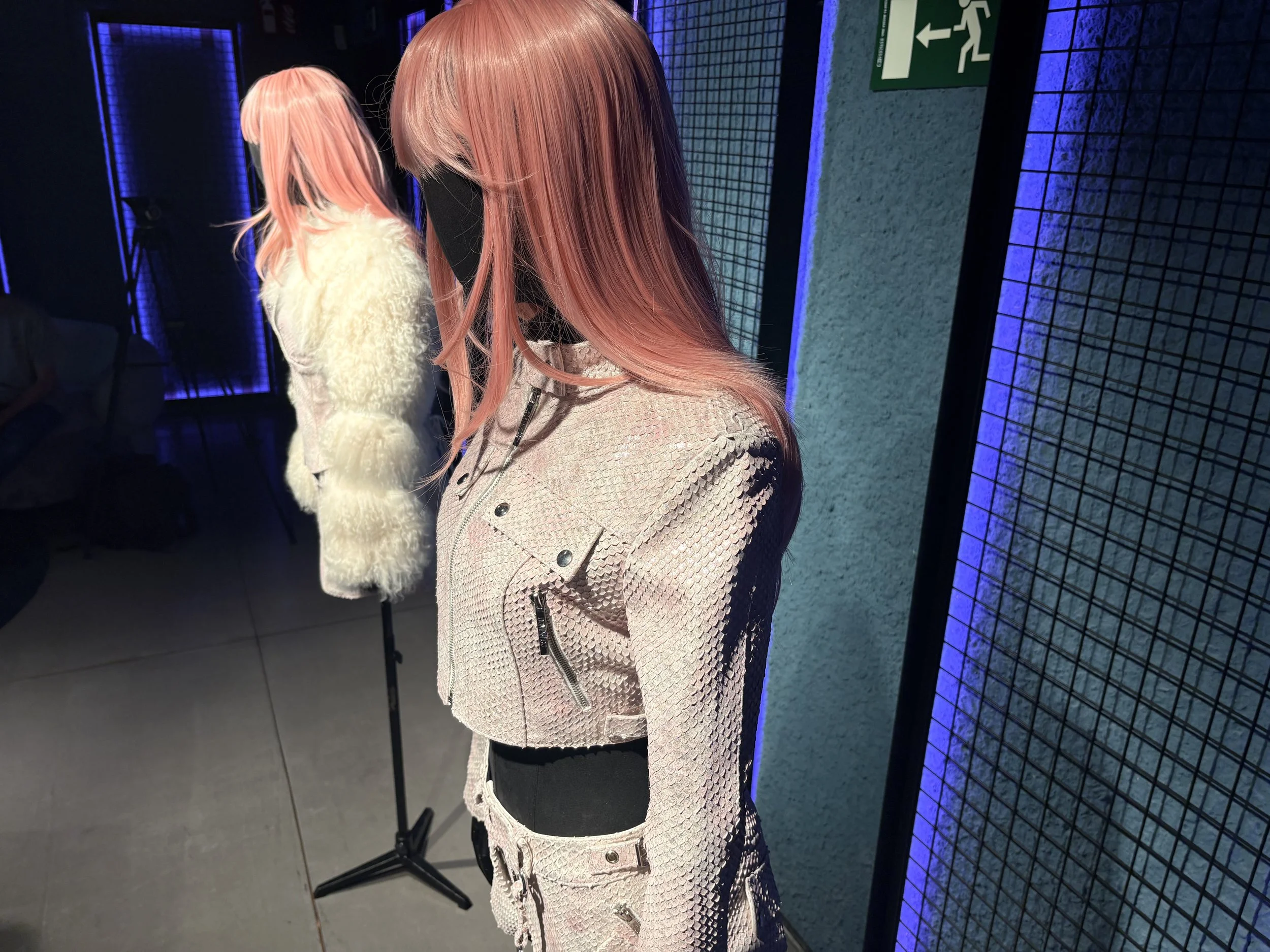
The pale reptile-effect set was perhaps the most unfortunate example. Between the scaled surface, silver hardware, cropped biker proportions, and minute bottom, the look accumulated visual information without gaining sophistication. The material may well be technically accomplished; visually, however, it read closer to novelty than sophistication.
There was also a curious commercial contradiction.
At first glance, the collection can appear almost aggressively impractical. Yet the constant reliance on two- and three-piece dressing actually makes much of Resort 2027 rather easy to understand as product. Jackets, skirts, corsets and tops can be separated, recombined and sold individually. So the problem is not necessarily that DOMINNICO has created something uncommercial.
It may be that it has created something too commercially familiar to its own customer.
Domingo has spent years building not merely clothes but an extraordinarily clear cultural position on queer visibility, sexual freedom, nightlife, and the kind of exaggerated self-expression that traditional luxury once treated as something to be domesticated. That community is one of the brand’s greatest achievements. There is genuine cultural value in creating a fashion space in which people who were historically peripheral to it all can recognise themselves at the centre of the image.
But cultural belonging can become a dangerous comfort zone for a fashion house.
If an audience already understands the corset, the skirts, the hardware, and the attitude as “DOMINNICO,” how much does the garment itself still have to surprise them? This collection occasionally felt like a brand protected by the strength of its own positioning.
The presentation did little to challenge that impression. Starting around fourteen minutes late would hardly constitute a crime, but once inside, the experience remained surprisingly underdeveloped. There was little to no music, little explanation, and little interaction from the team. A room covered in screens supplied the collection with some atmosphere, but atmosphere alone cannot perform emergency resuscitation on clothes.
The issue here is intentionality.
If you remove music, hospitality and elaborate staging, the clothing becomes even more exposed. In this case, that exposure revealed just how often one silhouette, one styling device, or one familiar house code was being asked to do the work of an idea.
And that is ultimately why Resort 2027 disappoints. Not because DOMINNICO lacks identity. Quite the opposite. The brand has accomplished something many young labels spend their entire existence attempting: it has become immediately recognisable. It has celebrity validation, a loyal audience, identifiable product and a decade of institutional legitimacy behind it.
That success should now permit greater risk, not less. Ten years into a brand’s life, recognisability should be the foundation from which a designer departs—not the destination to which every collection returns.
Resort 2027 understands perfectly what DOMINNICO looks like.
I’m less convinced it knows what DOMINNICO should become.
WRITTEN BY FREDDY ESPINAL
