
Juan Vidal Spring/Summer 2027
Six months ago, Edén began with seventy-two hours in Istanbul. Vidal came back interested in a city where sensuality and spirituality occupy the same streets, and built a collection around the pomegranate: fertility, knowledge, temptation, but above all coexistence. East and West. Concealment and revelation. Body and spirit. Antique embroidered Turkish textiles carrying birds, trees, and pomegranates were worked into clothes that treated the fruit as an aphrodisiac.
El Segundo Edén does not abandon that woman. It gives us spectators, a view of her in a different context of life.
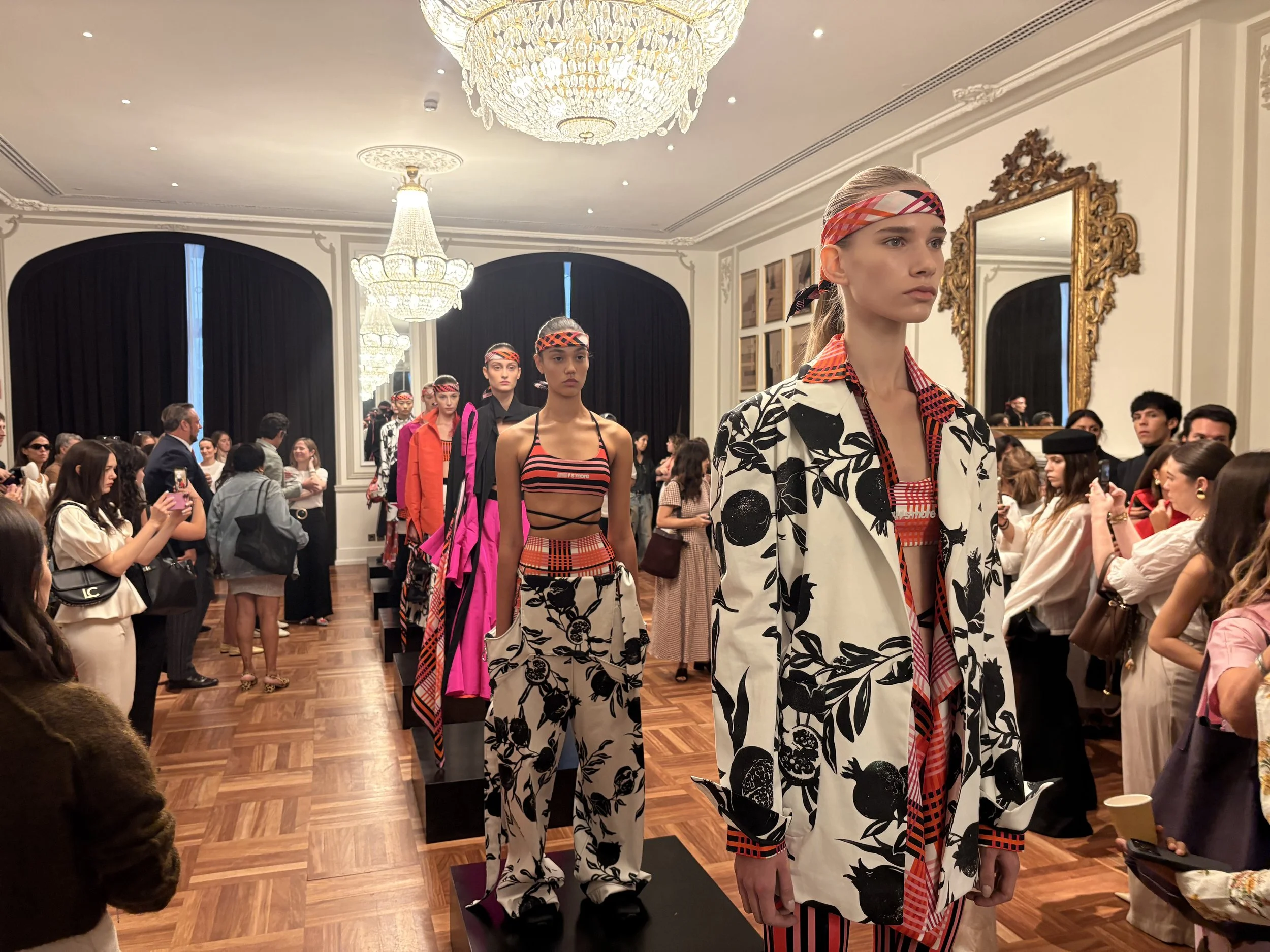
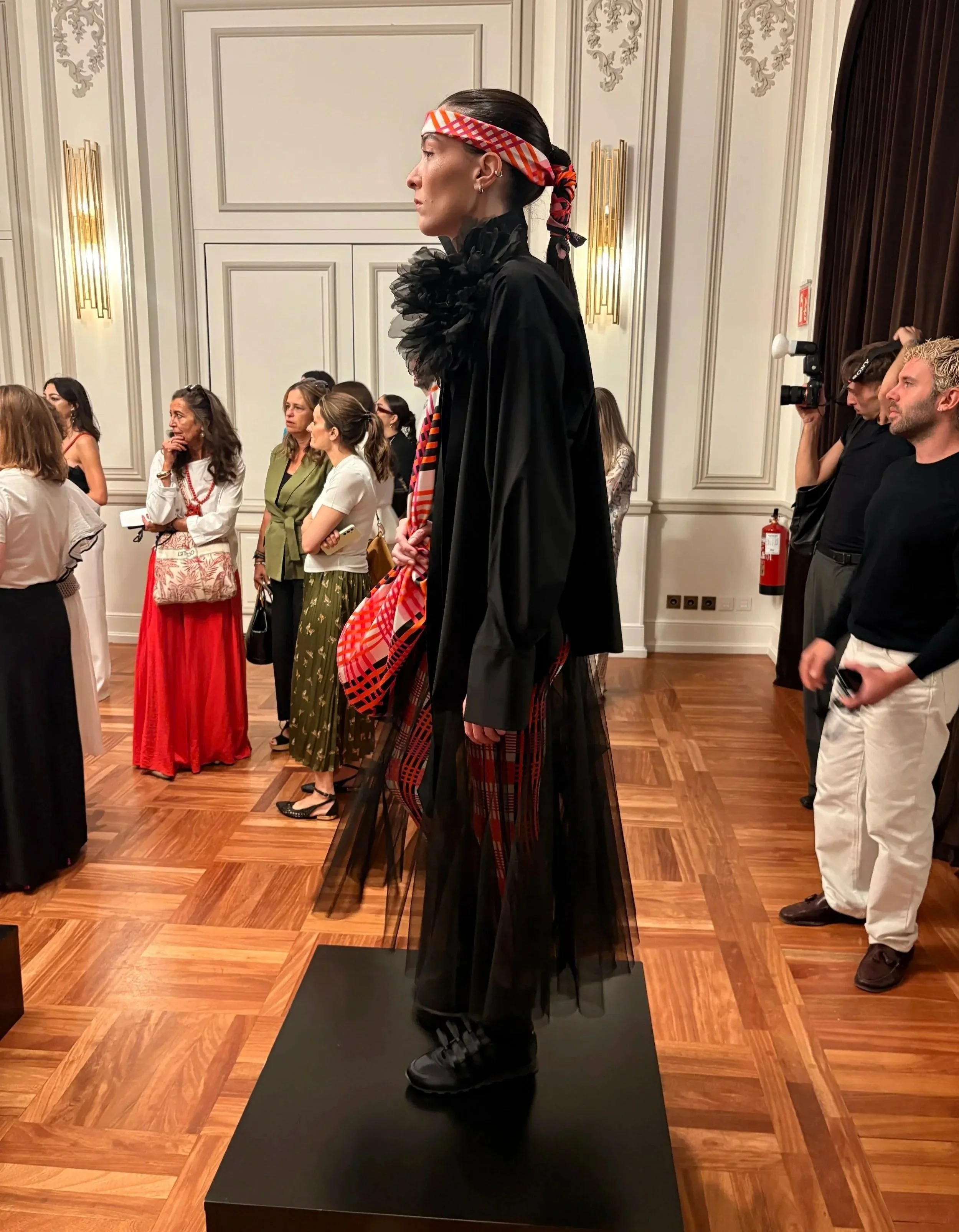
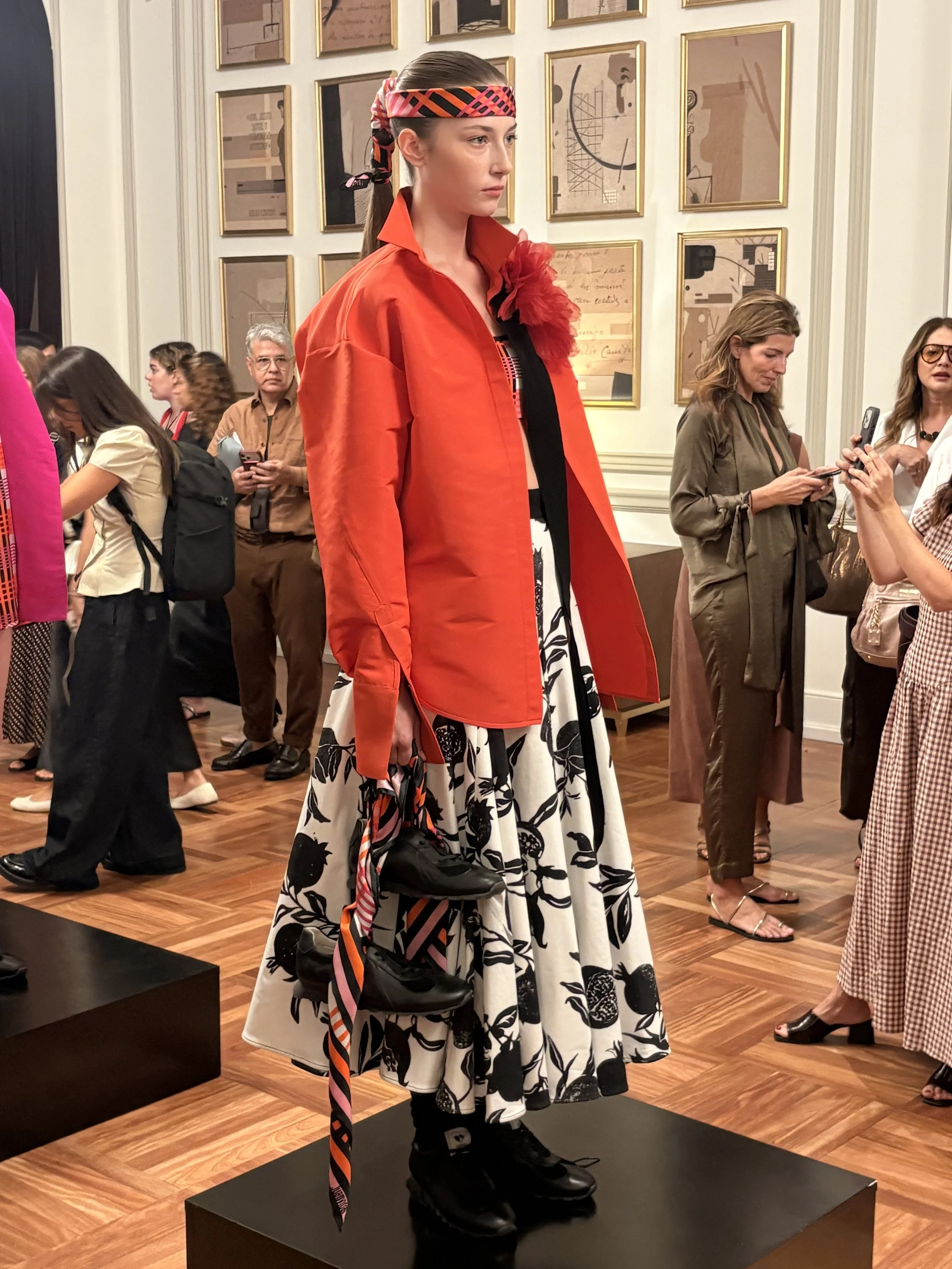
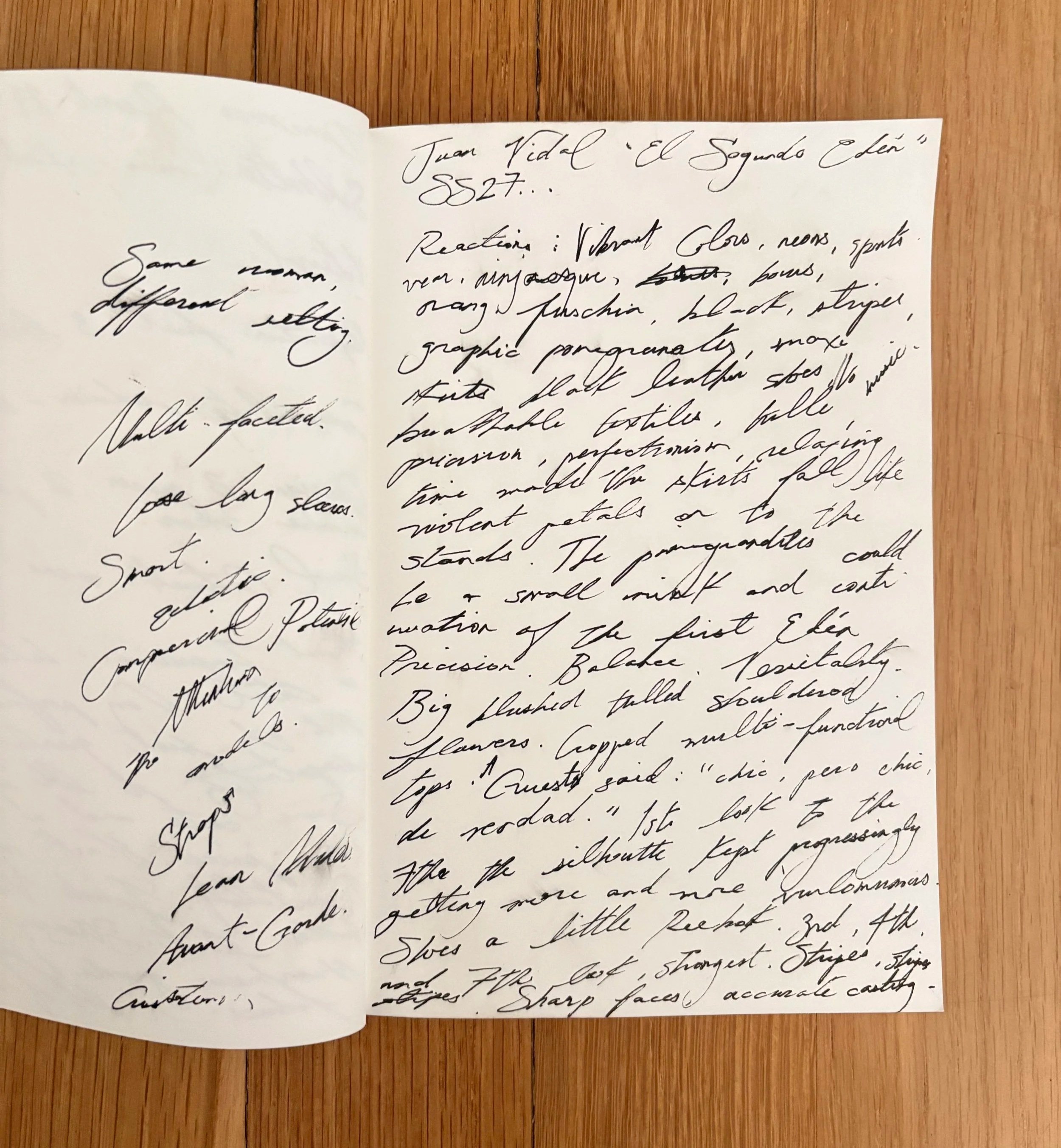
At The Palace Hotel in Madrid, seven women stood on black plinths in combinations of white, black, electric fuchsia, violent orange and a recurring family of red, pink and coral stripes. The pomegranate had survived, although considerably changed. Gone was some of the mystical density of the first Edén. Here the fruit was flattened into graphic black botanical silhouettes across white jackets, trousers and enormous skirts. Around it came cropped athletic tops, leggings, exposed waists, elongated shirting, scarves wrapped tightly around heads and ponytails pulled with enough determination to suggest that whatever these women were about to do, they intended to do boldly.
The effect was strangely athletic without becoming sportswear in the conventional sense. There was something combative about it. Ninja-esque, even. Not because Juan had resorted to costume, but because the styling established preparedness: narrow bodies, sharp-clean faces, tightly controlled hair, flat shoes, straps, and tied fabric.
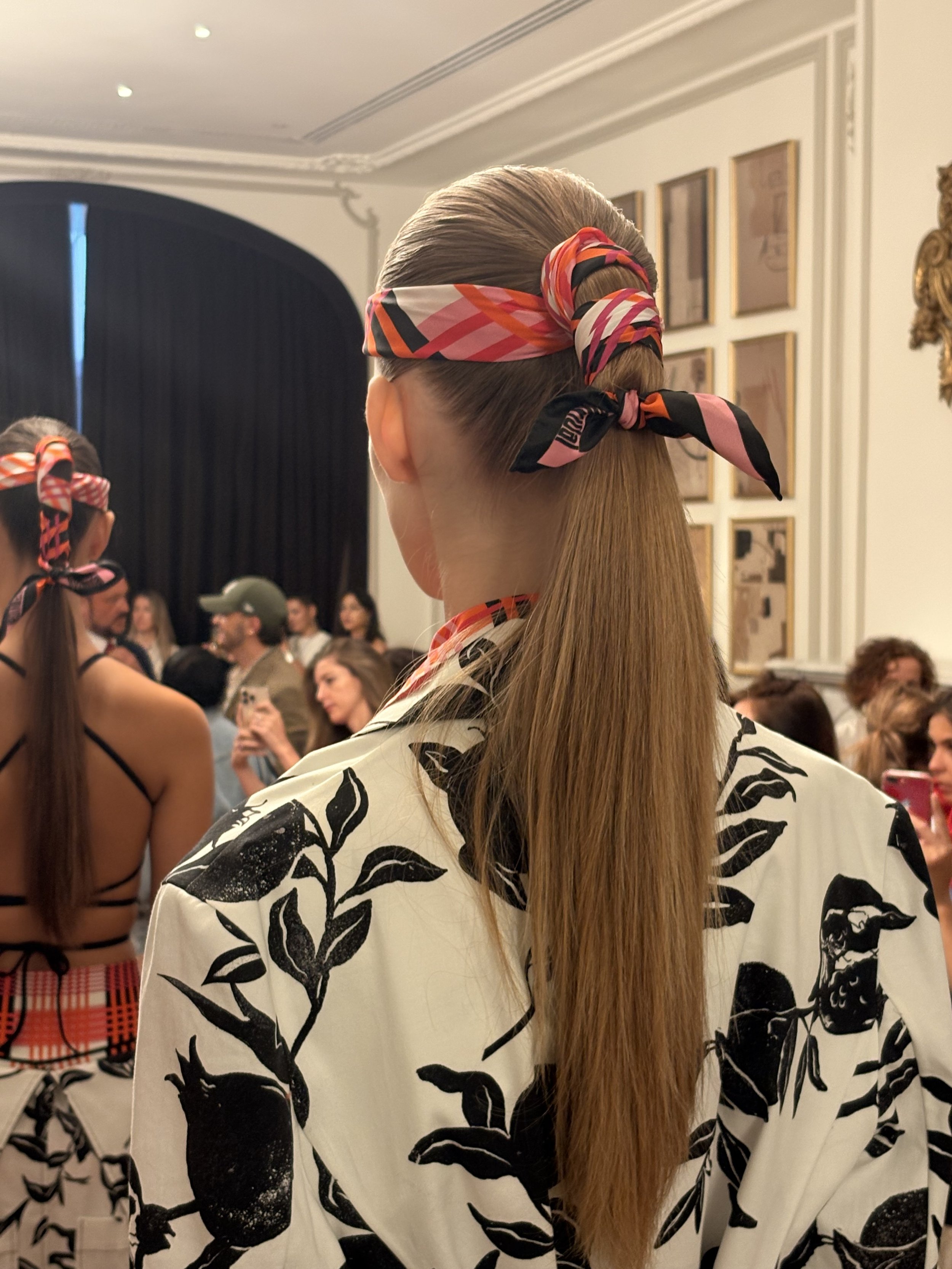
The models did not look only dressed for athleisure. They looked ready.
Vidal’s work has always depended on an almost contradictory relationship between control and seduction. He is the fourth generation of a tailoring family; he studied Fine Arts before fashion, and has spoken about inheriting from his father discipline and an obsession with the cut, the stitch and the press. ACME describes technical perfection carried to the smallest detail as one of the constants of his work. Watching him conduct El Segundo Edén, that biography stopped sounding like biography and became visible conduct.
For roughly half an hour he moved through the room inspecting the composition. A sleeve here. A skirt there. Fabric had to fall where fabric was supposed to fall. Nothing suggested the designer’s romantic cliché of chaos masquerading as genius. Vidal looked more like a conductor who had already rehearsed the orchestra and was now irritated by the possibility of one violin entering half a second late.
Then, out of nowhere, he called for “relaxing time!”
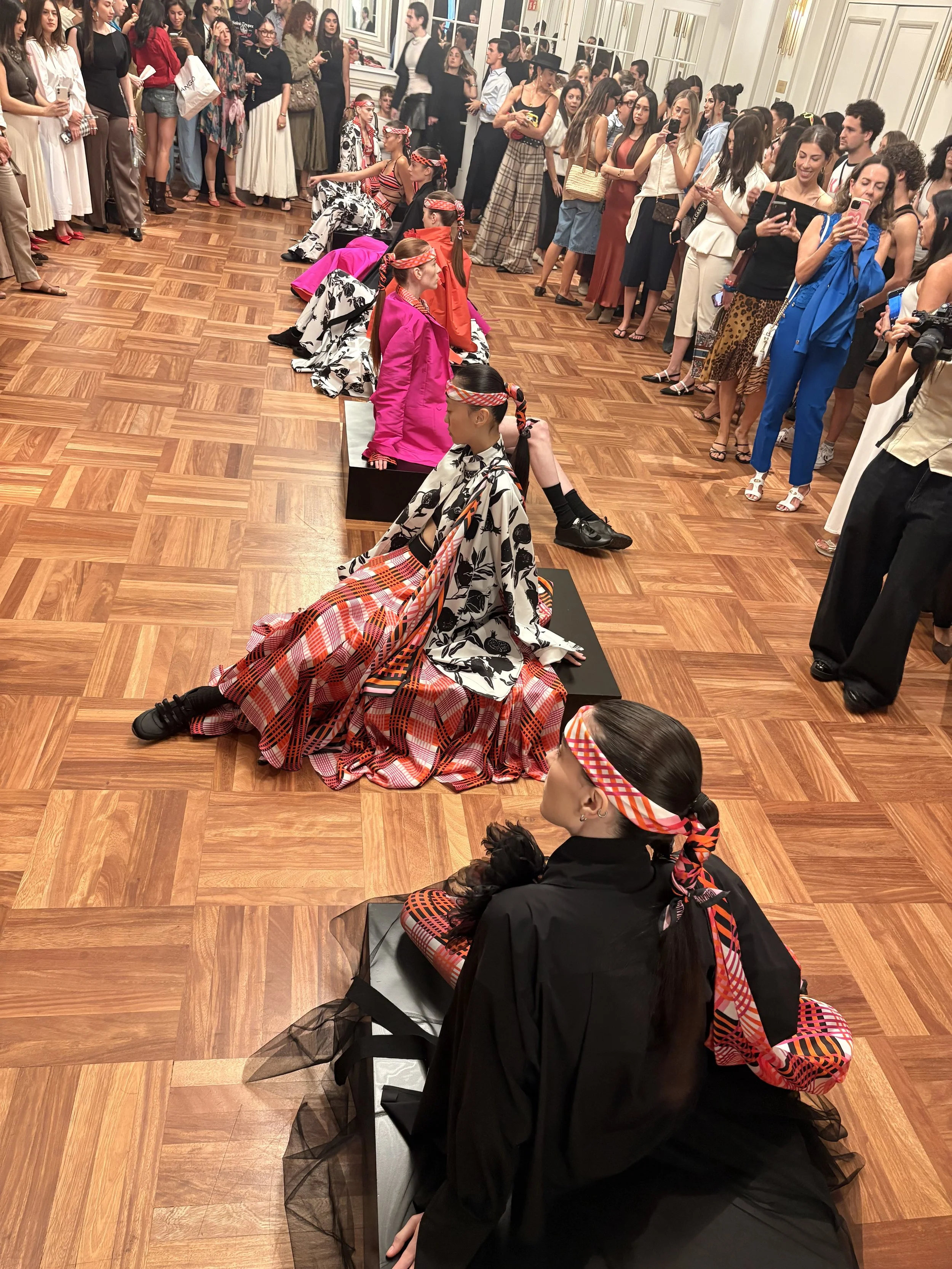
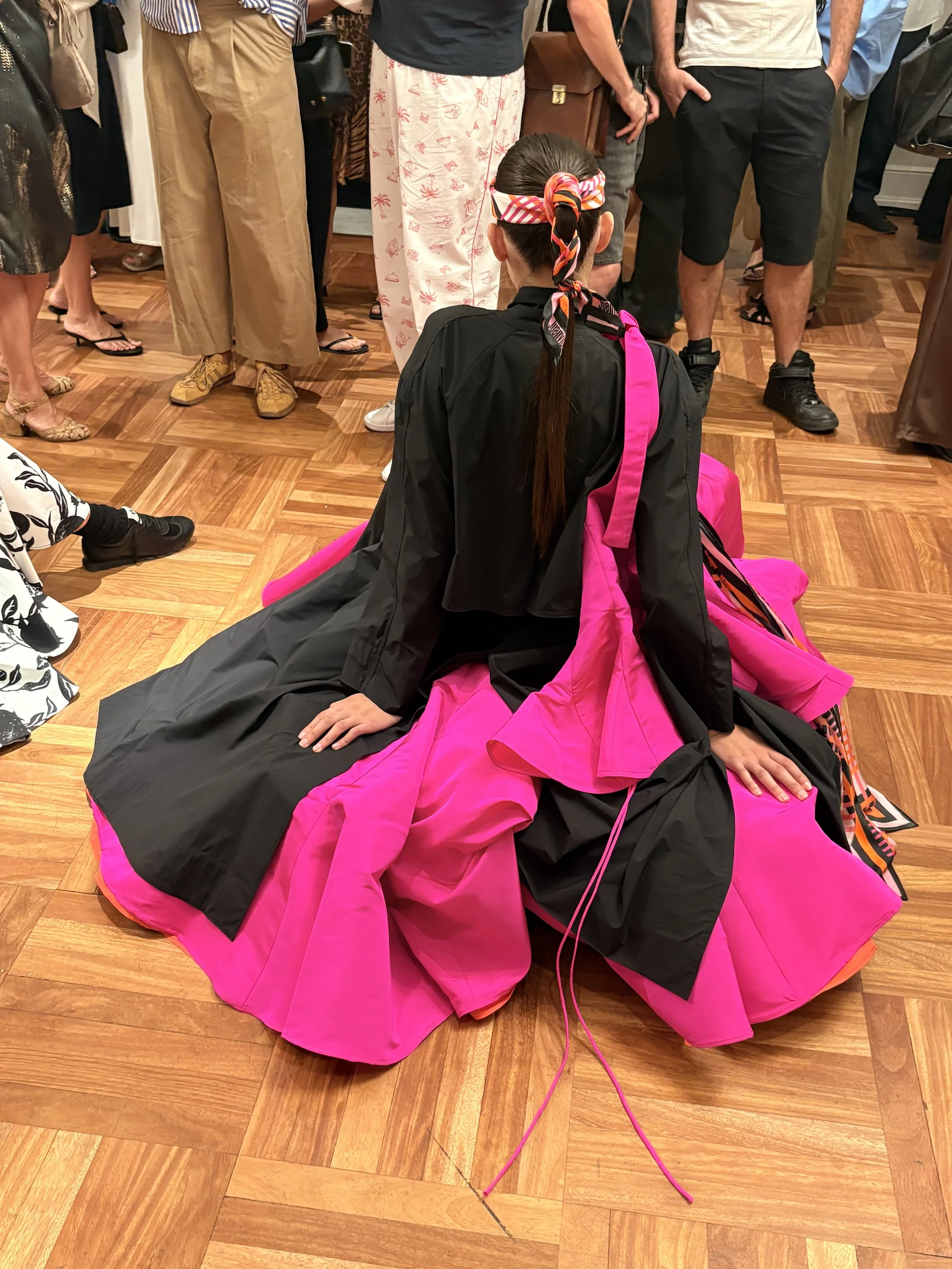
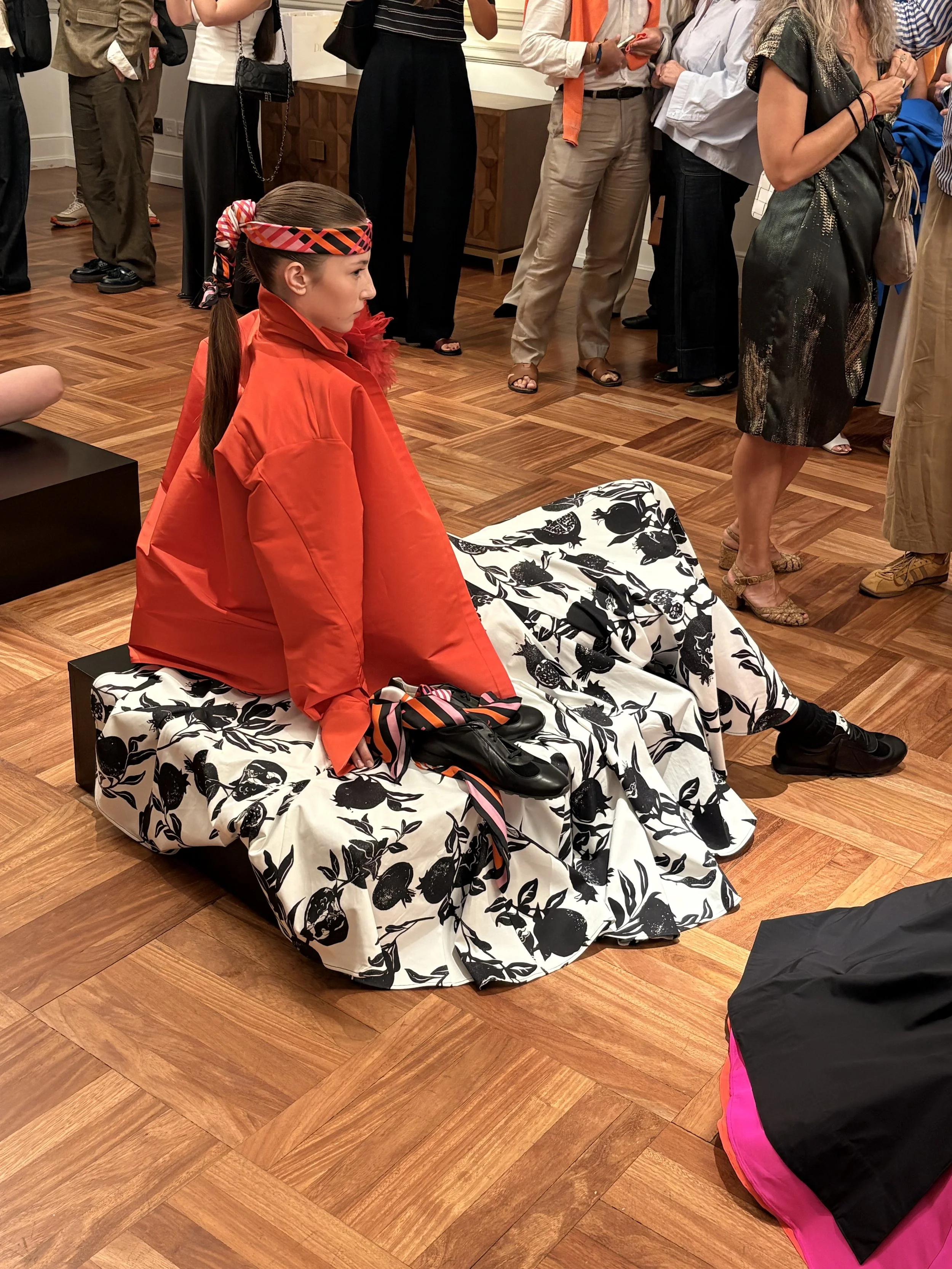
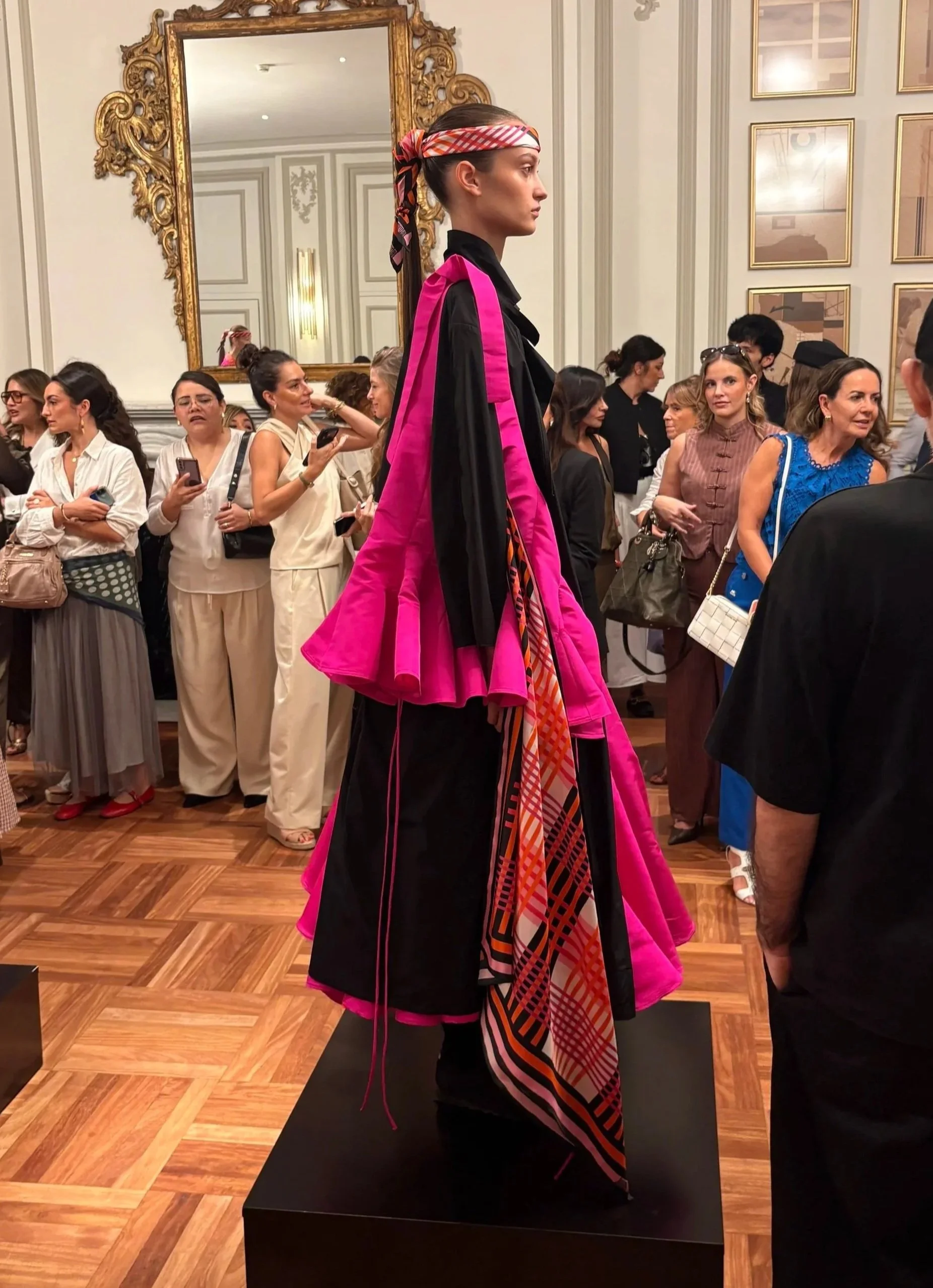
The models intentionally fell onto the black platforms with a collective grace that comes from seven people having spent the previous half hour being instructed precisely where to stand. And suddenly the collection changed. Skirts that had been architectural while vertical spread across the platforms and parquet. Layers of black, white, fuchsia and printed fabric pooled around bodies. One black-and-fuchsia look opened so widely beneath the model that the material read almost as petals.
For a Spring/Summer collection about a second Eden, all I can say is… touché.
More importantly, the moment revealed something about Juan’s control. Precision is considerably more captivating when it knows when to release itself. The clothes were meticulously arranged, but their beauty was not dependent on remaining untouched. When the bodies softened, the clothes did too. The volume did not collapse; it only bloomed.
That movement also clarified the sequencing of the seven looks. The presentation began relatively lean and accumulated material as the eye progressively travelled through the room. The earlier propositions were stripped closer to the body: leggings, cropped pieces, narrow straps, cleaner verticals. Then came increasing quantities of fabric, fuller skirts, additional layers, long shirting and eventually the most expansive silhouettes. The collection appeared to grow in front of you.
Look one established the first sentence. By look seven, Vidal was practically speaking in paragraphs.
And yet the clothes themselves are surprisingly easy to imagine selling.
That is one of the more intelligent things about this capsule. Its theatricality is modular. Remove the enormous skirt and the legging survives. Remove the printed jacket and the striped crop top functions independently. Take one of those graphic pomegranate skirts and put it with an ordinary black tank and suddenly the woman is no longer standing on a plinth at The Palace; she is simply well dressed. A cropped top could live with denim. The leggings could, quite literally, go to the gym. The voluminous pieces provide the image, but the collection does not require the customer to purchase the image as a whole.
A good look can seduce an editor. A useful wardrobe must survive being dismantled.
This collection understands both.
The recurring stripes were particularly effective in making those separate pieces speak to each other. Coral, black, pink, red, and white crossed and recrossed through leggings, bras, collars, and the scarves wrapped around the models’ heads. They created continuity without requiring repetition. Against the black-and-white pomegranate print, the geometry became sharper still: organic fruit colliding with controlled lines.
That is where El Segundo Edén most convincingly develops its predecessor.
In Edén, the pomegranate carried the intellectual thesis. It represented many seeds existing under one skin, and Juan used it to discuss cultural coexistence. In the second garden, the symbol has been stripped of some of its solemnity and put to work. The pomegranate is now a print, a graphic device, a commercial motif. The woman who once contemplated the garden appears to be exercising inside it.
There were still flowers, of course. Oversized floral gestures erupted from shoulders and necklines, most memorably against the harder orange shirting. Their scale prevented the athletic references from becoming sterile. Vidal has not suddenly become interested in functional minimalism. Thank God.
The shoes were the weakest objects in the room. Black, flat and vaguely Reebok-adjacent, they possessed very little to no personality of their own. I have never particularly liked that type of trainer, and El Segundo Edén did nothing to change that for me. But styling and product are different questions. As styling, they were smart. Anything more designed, precious or decorative beneath those skirts would have started another conversation at precisely the moment the clothes needed to finish theirs.
There was also no music.
Initially, I missed it. A soundtrack with the right pulse could have amplified the collection’s physicality, particularly the sense of sport, combat and forward movement already embedded in the clothes. Instead, the room sounded like what it was: cameras, conversation, people shifting around one another. Curiously, the silence also exposed Juan’s control. There was nothing sonic instructing you how to feel. Colour, casting, posture and clothes had to generate the feelings themselves.
They did.
The casting here deserves more credit than casting usually receives in a presentation. Juan chose lean, athletic-looking bodies and faces with enough angularity to withstand the graphic force of the clothes. Every ponytail was really pulled back; every printed scarf sat tightly around the head. Had the same clothes been styled with loose waves, ornate heels, and conventional glamour, all of the proposition would have disintegrated.
The Palace itself provided another useful tension.
Before entering Vidal’s salon, guests passed through a broader fashion installation in the hotel lobby—a selection unrelated to El Segundo Edén, including work from other designers. Then the doors opened onto something visually much more specific. White classical walls. Chandeliers. Parquet. Black platforms. And, suddenly, fluorescent fuchsia, vibrant orange, abstract pomegranates and seven women dressed as though Eden had hired a personal trainer.
The contrast slapped one in the face.
Despite the room being packed with photographers, press, and guests, the presentation somehow remained intimate. People could circle the models. Fabric could be inspected at close range. Construction was not protected by a runway’s several metres of distance. Juan himself remained attentive to the room, adjusting, greeting, answering, and watching.
At one point, I heard a guest look at the clothes and say:
“Esto es chic, pero chic de verdad.”
Normally I would distrust a review delivered within earshot of the designer.
Frankly, he was right.
What made this chic de verdad was the completeness of the proposition. The room, the bodies, the grooming, the discipline, the clothes and the designer’s own attention all seemed to understand the same idea.
Vidal has been around long enough that technical seriousness should no longer surprise anyone. Vogue’s Who’s On Next in 2013, the National Fashion Award for New Value in 2015, multiple L’Oréal prizes, and this year’s Spanish Fashion Academy award for Best Runway Presentation form a rather substantial paper trail. The question is therefore less whether Juan Vidal can make clothes properly than whether, after all these years, he can continue giving his woman somewhere new to go.
El Segundo Edén answers that rather elegantly.
He did not invent another woman. He proved to understand the one he already had. She still likes flowers. She still likes pomegranates. And she still remains attracted to colour, seduction and controlled excess. She has simply become busier.
Eden, apparently, now goes to Pilates.
And somehow Juan Vidal has made that chic de verdad.
WRITTEN BY FREDDY ESPINAL
